Home / Layouts
Keyboard case cost and spec by layout
The layout sets the size of the block a shop buys, the machine it needs, how many cases fit on an anodising rack and how hard it is to keep the bottom flat. Those four things decide most of the price difference between a 60 percent and a full-size case. The table below puts the layouts side by side with typical stock, mass and a modelled price band, so a designer can see the cost of a layout choice before any shop is asked.
keyboardcnc.com is a matching service, not a machine shop. We own no machines and publish no shop prices. Every figure on this page is either arithmetic on public data or the output of the published model in our case cost estimator. Treat it as a planning range.
The layouts side by side
| Layout | Key area, units | Key area, mm | Typical outside size, mm | Stock block, mm | Block mass, 6061 | Case mass, 6061 (model) | Price band per set (model) |
|---|---|---|---|---|---|---|---|
| 60 percent | 15 x 5 | 286 x 95 | 295 to 310 x 105 to 115 | 305 x 115 x 25 | 2.4 kg | about 0.77 kg | 111 to 185 USD |
| 65 percent | 16 x 5 | 305 x 95 | 315 to 330 x 105 to 120 | 330 x 120 x 25 | 2.7 kg | about 0.85 kg | 111 to 185 USD |
| 75 percent | 16 x 6 | 305 x 114 | 320 to 335 x 120 to 135 | 340 x 135 x 25 | 3.1 kg | about 0.92 kg | 129 to 214 USD |
| TKL | 18.25 x 6.5 | 348 x 124 | 360 to 375 x 135 to 150 | 375 x 150 x 25 | 3.8 kg | about 1.12 kg | 151 to 252 USD |
| Full size | 22.5 x 6.5 | 429 x 124 | 440 to 455 x 135 to 150 | 450 x 150 x 25 | 4.6 kg | about 1.33 kg | 182 to 304 USD |
Key area: key units times the 19.05 mm key pitch, rounded. Block: about 10 mm added to length and width, 25 mm plate. Case mass: top and bottom together from the open box model of the case weight calculator at its default walls. Price band: estimator output for a 6061 top and bottom set, gasket mount, Type II anodising, 150 units, tooling spread over the run, plus or minus 25 percent, ex works. Typical values, confirm with the supplier.
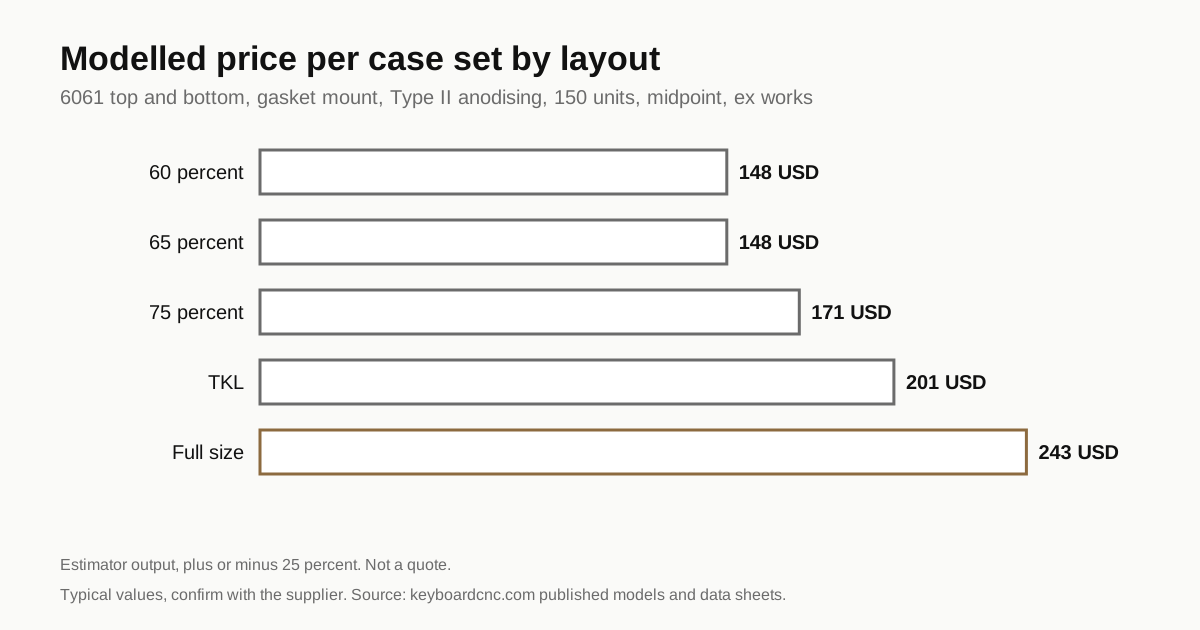
Two readings matter. The steps are not linear with key count: a 75 percent adds a row of keys but only about 15 percent to the modelled price, because the block barely grows. The jump from TKL to full size is the biggest, because the block, the machine and the rack all change class at once.
What changes with the layout
Stock
A shop pays for the block, not the case, and most of the block becomes chips. The block mass column is the metal on the invoice before any machining. Going from a 65 percent to a full-size block adds about 1.9 kg of 6061 per part. In brass or stainless the same step adds roughly three times that mass, which is why heavy metals are kept for weights and not for the whole case.
Plate is sold in standard widths and thicknesses. A layout whose block fits a standard plate width without waste nests better and is cheaper per part. Ask the shop which plate it would cut from and how many blocks it gets from one sheet.
Machine fit
Every layout from 60 percent to TKL fits the X travel of a common vertical machining centre with room for the vice or fixture. Full size and long 1800 layouts are where some shops run out of comfortable travel, have to use a larger machine at a higher hourly rate or decline. It is worth asking each shop which machine the case goes on before you compare prices.
Finishing
Anodising is charged per rack and per load as much as per part. A longer case takes more rack space and fewer parts fit per load, so the finishing cost per case rises faster than the area. Batch minimums matter too: a small run of full-size cases can pay the same load charge as a larger run of 65 percent cases.
Flatness
A long thin part moves when it is released from the fixture and again in the anodising tank. Rock, the case rocking on a flat desk, is the usual rejection on TKL and full-size runs. The fix is design (ribs, a stiffer bottom, a split case) and inspection (a written flatness check), and both cost money that a 60 percent run does not spend.
Cost drivers by layout
| Driver | 60 and 65 percent | 75 percent | TKL | Full size and 1800 |
|---|---|---|---|---|
| Block mass against 65 percent | 0.9 to 1.0 | 1.15 | 1.4 | 1.7 |
| Estimator layout factor | 1.0 | 1.2 | 1.45 | 1.8 |
| Machine class | Common VMC | Common VMC | Common VMC, check travel | Larger VMC at some shops |
| Rack density | High | High | Medium | Low |
| Flatness risk | Low | Low | Medium | High |
| Shipping carton | Small parcel | Small parcel | Medium | Long parcel, dimensional weight |
Estimator layout factor from the published model of the case cost estimator. Block mass ratio from the block sizes in the first table. Qualitative ratings are typical, not measured.
Choosing a layout on cost
- Price the layout before the mount. The layout factor and the mount factor multiply. A full-size integrated plate case carries both the largest layout factor and the largest mount factor.
- Use the same block for two layouts. A 60 and a 65 percent case can often share block size and fixturing, so one run can carry both at little extra setup cost.
- Treat full size as its own project. Ask about machine travel, flatness and rack space in the first email, not after the prototype.
- Budget shipping per layout. Dimensional weight on a long carton can cost more than the case mass suggests.
Each detail page below covers one layout: the block, the cuts that drive time, the weight options and what to put in the RFQ. The reasoning behind the factors sits in where the money goes, and the comparison between the two largest layouts is worked through in TKL vs full size.
What to send with a layout
A shop can quote a layout faster when the request carries the outside size, the case height at front and back, the mount style, the alloy and temper, the finish and the quantity at two or three break points. The RFQ template lists every line. Mounting style changes the price inside each layout, and the mounting styles page prices each one.
Common questions
How much more does a TKL case cost than a 65 percent case?
On the published model of our case cost estimator, a TKL top and bottom set in 6061 with a gasket mount at 150 units comes out about 35 percent above a 65 percent set: a midpoint near 201 USD against 148 USD per unit, ex works. That is a planning figure, not a quote. The real gap depends on depth, setups and finishing rack space.
Is a 60 percent case cheaper to machine than a 65 percent case?
Barely. The two use nearly the same block and fit the same machines, so the estimator prices them with the same factor. The arrow cluster of a 65 percent adds a little programming and a tighter bottom edge, not a different class of job.
Why does the full-size case jump so much in price?
Three things stack. The block is about 70 percent heavier than a 65 percent block, the part needs a machine with more X travel and fewer parts fit on an anodising rack or in a shipping carton. Flatness over 440 mm is also harder to hold, so more cases are rejected for rock.
Which layout is the best first group buy?
A 60 or 65 percent case. It fits the widest range of machines, it has the lowest stock and finishing cost per unit and it is the size most shops have already cut. A first run with fewer variables is a run more likely to ship on time.
Sources
- Kaiser Aluminum, alloy 6061 technical data (density 2.70 Mg/m3, hosted by Proto Labs)
- Wikipedia: Keyboard layout (physical layouts and form factors)
- Wikipedia: Computer keyboard (key pitch of 19.05 mm)
Last reviewed 22 October 2026
Have a case drawing to quote?
Send the files through the RFQ form. We reply within 24 business hours and match the request with up to 3 shops. They quote you directly.
Send your drawings