Guides / Cost
TKL and Full-Size Keyboard Cases: Stock, Machine Time and Price
October 25, 2026
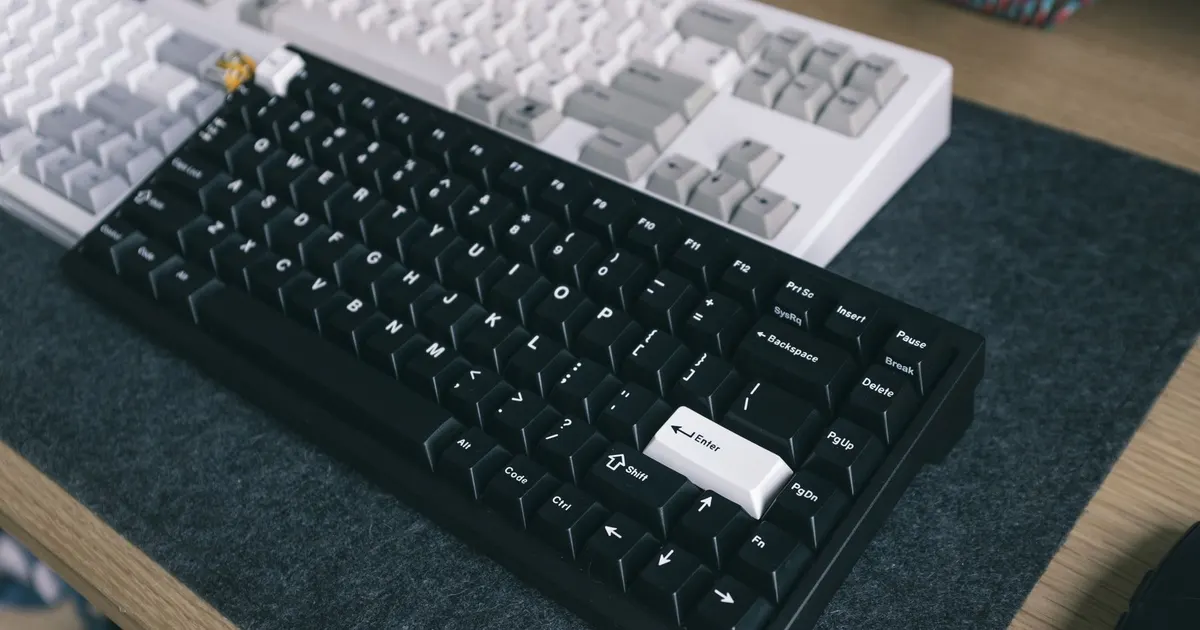
A mechanical keyboard comes in sizes that grew out of the same typewriter layout, and each step up adds keys and width. For a buyer the difference is a few more keys. For a shop it is a bigger block, a longer pocket, a longer blast, a bigger anodising tank and a smaller list of machines that can take the job.
This guide compares the tenkeyless (TKL) and full-size layouts with the 65 percent that most shops quote first. It explains where the extra cost comes from, so that you can judge whether a quote is reasonable.
The sizes
Key area is set by the layout and is measured in key units of 19.05 mm. The case adds a bezel around it.
| Layout | Keys, about | Key area, units | Key area, mm | Typical case outside size |
|---|---|---|---|---|
| 65 percent | 68 | 16 x 5 | 305 x 95 | 315 to 330 x 105 to 120 mm |
| TKL | 87 | 18.25 x 6.5 | 348 x 124 | 360 to 375 x 135 to 150 mm |
| Full size | 104 | 22.5 x 6.5 | 429 x 124 | 440 to 455 x 135 to 150 mm |
A TKL has the function row and the navigation cluster but no number pad. A full-size board adds the number pad. The extra four key units for the number pad make a full-size case roughly 80 mm longer than a TKL.
Plan area and block mass
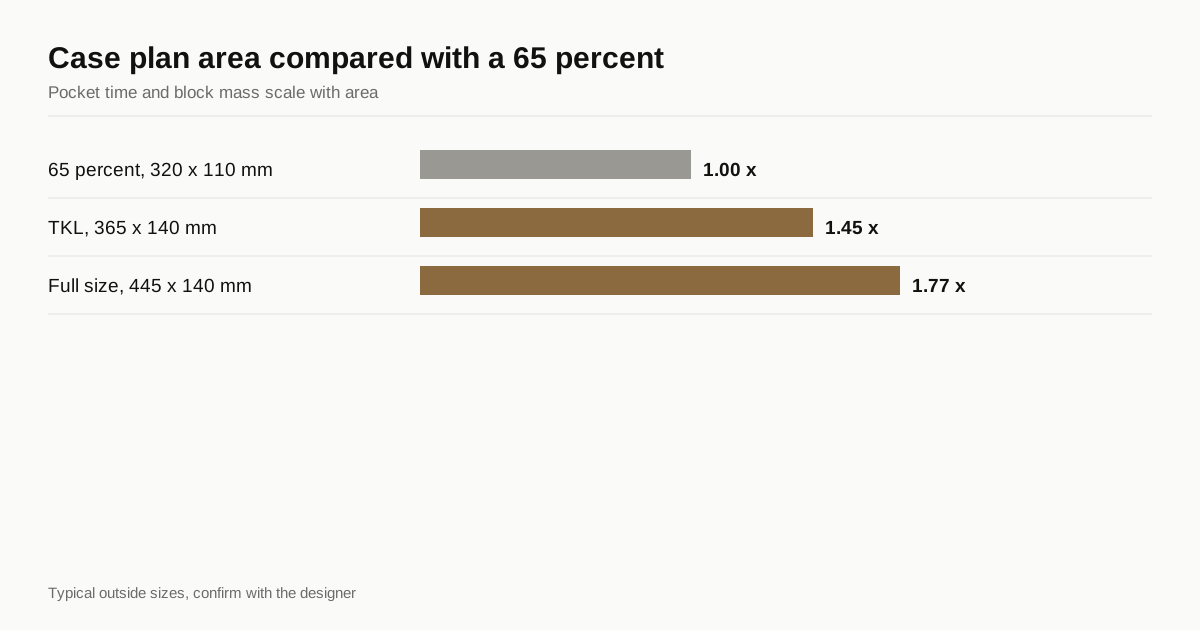
The simplest way to compare layouts is by plan area, the length times the width of the case. Taking a 65 percent case at about 320 x 110 mm as the baseline:
- TKL, at about 365 x 140 mm, has about 1.45 times the area.
- Full size, at about 445 x 140 mm, has about 1.77 times the area.
The block follows the same ratios. At 25 mm plate and the usual allowances, block mass is roughly 2.7 kg for a 65 percent, 3.8 kg for a TKL and 4.6 kg for a full-size case. The calculation is in aluminium plate stock sizing. Material costs more with the larger sizes, though it is the smaller part of the extra price.
Machine time
Most of the cutting time goes into the large pocket under the plate. Pocketing time grows with area, so a TKL takes roughly 1.4 to 1.5 times the pocketing time of a 65 percent and a full-size case about 1.7 to 1.8 times. Setups and the outer profile grow more slowly, since the extra length adds only straight cuts.
The effect on price is usually a little steeper than the area ratio, because three other things grow as well.
- Finishing passes. A long flat face needs a long finishing pass with a sharp tool, and any chatter shows across a larger surface.
- Inspection. More surface to check, more screw bosses and a longer flatness measurement.
- Scrap. A defect on a larger case wastes more metal and more machine time.
Real quotes vary, and the shop’s own mix of machines matters, so ask for the breakdown into machining, finishing and tooling. The wider picture is in what a machined case actually costs.
Machine travel and shop choice
A full-size case is big for a keyboard case and not for a machine. It still matters because a block of 450 mm plus a fixture needs about 500 mm or more of travel along the long axis, and many compact mills offer less. A shop that has no machine of that size cannot quote it at all, and one that has a large machine charges a higher hourly rate for it.
That limits your choice in three ways:
- Fewer shops can quote. The pool is smaller, so there are fewer quotes to compare.
- Higher hourly rate. A big machine costs more to run, and the case pays for it.
- Fewer cases per setup. A 65 percent case may run two up on a plate. A full-size case usually runs one.
A TKL sits between the two. A 365 mm case fits most shops with a normal mill, but not the smallest benchtop machines.
Finishing and racking
Blasting and anodising scale with surface area and with the size of the tank and the rack.
- Blast time. A larger surface means more time in the cabinet, and the risk of banding on a long flat face is higher. See bead blasting before anodising.
- Tank size. The part has to fit the anodising tank with room for the rack. A tank used for small parts may not take a 450 mm case, and a finisher with a long tank is a narrower choice.
- Rack space. A big case uses more of each rack, so fewer cases go through per load and the cost per case rises.
- Colour consistency. A large flat surface shows differences in colour and texture more easily than a small one.
If the case is anodised by a separate vendor, confirm the tank length before the first part is cut. It is a cheap question and an expensive surprise.
Flatness and rock
Long parts bow. A long, shallow case with a large internal pocket holds residual stress and shows it when the pocket is cut. A bow of a tenth of a millimetre across a 450 mm case is a smaller proportion than the same bow on a 300 mm case, but it is easier to see and to feel as rock on a desk.
The defences are the same as for any case: stress relieved plate, roughing before finishing and balanced cutting from both sides. The check is described in inspecting a keyboard case. A full-size case should have a firmer plan for flatness than a 65 percent, because the same bow shows more.
Shipping and packing
Bigger cases are heavier and longer, and they cost more to ship.
- Weight. A finished full-size case with a weight can pass two kilograms before the board is built.
- Carton size. Parcel carriers charge by dimensional weight, so a long box costs more than a compact one even at the same mass.
- Protection. Longer cases flex more in transit, and corners take more damage. Packing needs to be better, which is one more cost line.
For a group buy shipped to many addresses, a few dollars more per board at each stage becomes a visible part of the price. Add it to the model before you set the sale price.
Layouts between the sizes
Several popular layouts sit between the ones above, and they fall on a sliding scale.
- 75 percent and 80 percent. These pack the function row and arrows into a case only a little longer than a 65 percent. They cost a bit more than a 65 percent and well under a TKL, and they are the usual answer for buyers who want a function row without the width.
- 96 percent and 1800 style. These squeeze a number pad into a case that is shorter than a full-size one. The dense key packing means a tight internal pocket with many small features, so the machining effort is higher than the size suggests.
- Number pad only. A separate number pad is a small case, covered in macropad and numpad cases.
When you compare quotes between layouts, compare cost per key as well as cost per case. A 96 percent can look expensive by area and cheap by key, and a buyer who wants the extra keys will weigh it that way.
How to decide
Pick the layout for the buyer first and the cost second, but use the cost to check that the plan is realistic.
- If the market wants a TKL, build a TKL. The extra cost is moderate and the pool of shops is still wide.
- If the market wants a full-size, quote early and confirm that your shop has the machine and the tank. Allow a longer lead time and a firmer flatness plan.
- If you are unsure, run a 65 percent or a TKL first. The layouts are the lowest risk for a first run, and the lessons carry over. The sequence is in the custom case guide.
The case cost estimator shows how plan area and the other factors feed into a rough number, which helps when you compare layouts.
Before you request a quote
- Layout and outside size stated
- Machine travel and tank length confirmed with the shop
- Flatness limit and stress relief method agreed
- Shipping weight and carton size estimated
- Quantity set in units that match the finishing batch
For the whole budget around layout, see our guide to keyboard case manufacturing cost.
When the layout is settled, send the files through the RFQ form and we will match them with shops that can take the size.
Frequently asked questions
How much more does a full-size case cost than a TKL?
The plan area is about 20 to 25 percent larger, so block mass and pocket time rise by a similar share, and the finishing line takes more rack space. Expect a clearly higher price, with the exact gap set by the shop's machine and tank sizes.
Can any shop make a full-size keyboard case?
No. A full-size case needs a block of about 450 mm, and the shop needs enough machine travel, a fixture for it and an anodising tank that takes the length. That shortens the list of shops that can quote it.
Why does a longer case rock more?
A long, shallow part holds more residual stress and bows more when pockets are cut, and a small bow at the centre is more visible across a longer base. Stress relieved plate and a rough then finish routine reduce it.
Need a quote for your case?
Send the files. We match you with up to 3 shops that machine keyboard cases and reply within 24 business hours.
Get matched with a keyboard case shop