Guides / Finishing
Bead Blasting a Keyboard Case Before It Is Anodised
October 12, 2026
Most anodised keyboard cases that look soft and matte were bead blasted first. The blast is the texture. Anodising on top of it adds colour and hardness but, being transparent, it shows every detail of the surface underneath. A blast that is uneven comes through the anodise as an uneven case, and nothing later in the process hides it.
That makes blasting one of the most important finishing steps and one of the least discussed. This guide covers what it does, what the choices are and how to ask for a result you can actually accept.
What the blast is doing
A machined aluminium surface carries tool marks. Even a good finishing pass leaves faint lines, and anodising makes those lines easier to see rather than harder. A blast breaks them up into a uniform texture, so the eye reads the surface as a single matte colour instead of a pattern of tool paths.
It also removes light scuffs and small handling marks from machining. This is useful, and it is also why blasting is usually done after all the cutting has finished. A blast followed by more machining would leave cut surfaces that do not match the blasted ones.
Blasting is not a repair. A deep scratch survives a fine blast and shows up again after anodising, so a part with one is scrapped rather than rescued. The cosmetic standard you agree with the shop should say so, and the same point is made in cosmetic scrap and overage.
Media and the look it gives
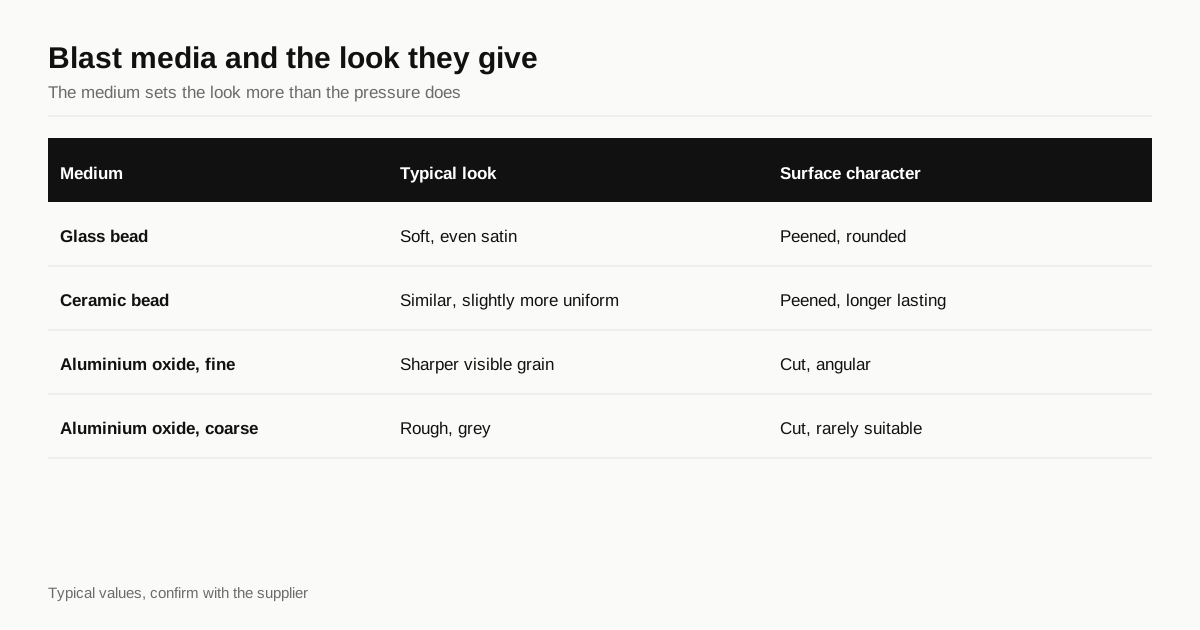
The medium sets the look more than the pressure does. These are the common choices for aluminium.
| Medium | Typical look | Surface character | Notes |
|---|---|---|---|
| Glass bead | Soft, even satin | Peened, rounded dimples | The usual first choice for a refined matte |
| Ceramic bead | Similar to glass, slightly more uniform | Peened | Lasts longer in the cabinet |
| Aluminium oxide, fine grit | Sharper, more visible grain | Cut, angular | Gives a more textured, grippy look |
| Aluminium oxide, coarse grit | Rough, grey | Cut | Rarely suitable for a visible case surface |
| Steel shot | Not used on a finished case | Heavy peening | Can embed iron and cause staining |
Glass and ceramic beads are the starting point for most cosmetic cases because peening rounds the surface instead of cutting it. A fine aluminium oxide grit gives a slightly sharper look that some designers prefer, particularly in darker colours, where it hides fingerprints a little better.
Media is described by a size. Glass beads are graded by sieve size and oxide by grit number, and a finer number or smaller bead gives a finer texture. Ask the shop for the medium and size by name, and ask for a sample on a scrap piece of the same alloy. A name such as “fine blast” means different things in different shops.
Why consistency is the hard part
The look of a blast depends on four things the operator controls and the eye is very good at spotting when they change:
- Pressure. A higher pressure peens harder and gives a coarser, duller surface.
- Distance. The nozzle further away spreads the stream and softens it.
- Angle. A nozzle at ninety degrees gives a different texture from one at forty five.
- Dwell. Time over one area. Too long leaves a patch that reads as darker or flatter.
On a long flat face such as the top of a case, any change in these shows as a band or a patch. Hand blasting depends on the operator staying consistent across thousands of passes. A robot or a rotating fixture improves that, and some shops use one for flat faces and hand blast the rest.
This is why a golden sample matters. Words like “uniform” and “even” cannot be measured. A sample that the buyer has approved can be, because the shop and the buyer are both looking at the same object. See colour matching across a run for how the golden sample is used on both sides.
Dark colours show the blast most
The same blast looks different under different anodise colours:
- Clear and light silver are forgiving. The metal underneath carries the look.
- Mid tones show a patchy blast but not harshly.
- Black and deep colours are the least forgiving. A darker dye gives the surface less light to hide in, and a variation in texture shows as a variation in sheen.
If your design uses a deep colour on a large flat face, ask the shop how they control blast consistency on that face and consider a slightly finer, more forgiving media. The reasons dyes behave this way are covered in anodising keyboard cases.
What blasting does to dimensions and fits
Blasting removes a small amount of material and also raises the surface slightly in places. On most faces this does not matter. On a plate pocket, a gasket shelf or a screw boss where a fit has to hold, it can.
Shops handle this in one of three ways:
- Mask the fit. The critical surface is covered during the blast and left as machined.
- Allow for it. The machined size is nudged to compensate.
- Blast only what shows. Hidden internal surfaces are not blasted at all.
If a fit is tight, mention it on the drawing and ask which method the shop uses. The same logic applies to anodising, which adds thickness of its own. The tolerances guide shows how to separate the fits that matter from the ones that do not.
Threads and holes
Blast media gets into holes and threads, and media left in a tapped hole can jam a screw or release grit later. A shop should plug or mask threaded holes, blow them clean afterwards and check them with a gauge or a test screw. Tell the shop which holes are threads, since an anodised thread is slightly smaller than a machined one and a few shops choose to tap after finishing instead.
How to write the blast into your spec
A usable blast specification names five things:
- Medium and size. For example “fine glass bead”, with the shop’s own size designation.
- Zones. Which faces are blasted and which are left machined.
- Reference. An approved sample, kept by both sides.
- Inspection conditions. Distance and light. The cosmetic standard template gives a workable default.
- Defect limits. Whether patchy texture on the top face is allowed at all. Usually the answer for the primary zone is none.
Two further points help. First, ask whether blasting and anodising happen at the same site or with a transfer between them, because every handover is another chance for handling marks. Second, ask what the shop does when a case fails the blast, since the answer is almost always to make another, and that belongs in the overage you agree up front.
Test the blast on a prototype, not on the run
A blast that looks right on a small test coupon can look different on a full size case, because the case has long faces, edges and corners where the nozzle moves differently. The cheapest way to find out is to blast and anodise a prototype in the real colour and compare it with the sample you meant to match. The reasoning is the same as for a prototype case: you find the problem while it costs one part and not two hundred.
Check four places on that prototype:
- The middle of the top face. Look for bands, patches and a visible change of texture along the direction the nozzle travelled.
- The edges and chamfers. Edges often get more blast than faces because the stream catches them from two sides, and they can look slightly rounder or duller.
- The inside of the front lip. Corners trap media and are sometimes missed, leaving a smoother patch.
- The hidden zones. If the underside is blasted differently from the top, you want to know whether that is intentional.
If something is wrong, tell the shop what you see and what you expect, and give them the sample. A shop that can adjust pressure and distance usually fixes a consistency problem in one more attempt. A shop that cannot is telling you something about how they will manage two hundred.
What it adds to the quote
Blasting is cheap compared with machining, but it is not free, and it scales with surface area and operator time rather than with quantity. A large case with a large flat face needs more careful blasting than a small case. It also rarely appears as its own line, so ask where it sits. A clear answer is “inside the finishing line, by area”, and a vague one usually means it has not been priced carefully.
Before you order
- Medium and size named, with a sample on the same alloy
- Zones marked: blasted, machined, hidden
- Fits that must hold marked on the drawing
- Threads masked or tapped after finishing
- Golden sample approved and kept by both sides
When the spec is ready, send it through the RFQ form and we will match it with shops that run blast and anodise as one controlled process.
Frequently asked questions
What is the difference between bead blasting and sandblasting?
Sandblasting is the general term for propelling abrasive at a surface. Bead blasting usually means glass or ceramic spheres, which peen the surface into a soft satin texture, while angular media such as aluminium oxide cuts it and leaves a sharper grain. Most keyboard cases use a bead or fine oxide blast, and the shop should name which.
Does blasting change the dimensions of a case?
It removes a very small amount of material and moves the surface slightly, which matters on a tight plate pocket or a gasket shelf. Shops usually mask critical fits or allow for the effect in the machined size. Ask how they treat any fit that matters.
Why does one case look different from another in the same batch?
Blasting is done by hand or by a robot with pressure, distance and angle set by the operator. Small changes in any of them alter the texture, and a dark anodised colour shows the difference far more than a light one. A golden sample and a written zone standard keep the batch together.
Need a quote for your case?
Send the files. We match you with up to 3 shops that machine keyboard cases and reply within 24 business hours.
Get matched with a keyboard case shop