Guides / Finishing
Specifying E-White So Cases Match Each Other and the Keycaps
October 31, 2026

E-white is a white finish applied by electrophoretic coating, which is why the keyboard community calls it e-coat white. The colour is hard to hit for three reasons. Anodising cannot make white at all, so you rely on a coating whose colour depends on a bath, a bake and a pigment lot. White shows the smallest shift in tone more than any other colour. And a case is judged next to keycaps, a PCB and other cases, so a difference you could not measure on a bench shows up on a desk.
This guide explains what e-white is, what moves its colour and how to specify a measured target so a run of cases matches each other and the board they belong to. It is a buyer’s guide. No public tolerance standard exists for this finish, so most of the work is agreeing numbers with the coater.
What e-white is
Anodising converts the aluminium surface into a porous oxide and fills it with dye. Wikipedia’s anodizing article states that white cannot be applied this way because the dye molecules are larger than the pores of the oxide. The film is also translucent, so the metal shows through. The same article notes that some advanced variations can produce a white coating with 80% reflectivity, which is a long way from a flat, opaque white.
Electrophoretic coating works the other way. The part sits in a bath of coating particles and an electric field pulls them onto the metal. Wikipedia’s article on electrophoretic deposition describes four steps: preparation, coating at typically 25 to 400 volts DC, rinsing and baking. The bath can contain pigments and fillers, and baking crosslinks the polymer so the film flows out smooth and continuous.
Two properties from that article matter for a white case. The film is more resistive than the metal, so current falls as the film thickens and deposition slows. And the coating is very uniform and reaches inside cavities. An opaque, even film is exactly what a flat white needs, and it is the reason e-coating beats anodising when the colour is white.
Retail listings use “E-White” as a plain colour name for white aluminium cases. One maker lists its white option as electrophoresis-coated aluminium, which matches the process above. Treat the label as a colour name, and ask the shop for the actual process and coating on your quote.
Why white is the hardest colour to match
A white sample can drift in two directions at once. It can get lighter or darker, and it can shift towards yellow or blue. X-Rite’s explanation of the ASTM E313 indices defines yellowness as how far a near-white surface has moved from preferred white towards yellow. The same page warns that a single whiteness number cannot separate how white a sample is from its colour drift, which is why the CIE whiteness index was developed.
For a buyer, the practical lesson is that “looks white” is not a specification. Two cases can both look white at arm’s length and sit visibly apart on a desk. Colour in the near-neutral range is also where metamerism is most common. Wikipedia notes that metameric matches are common in near-neutral or whitish colours, meaning two samples can match under one light and not under another.
Add the neighbours. The keycaps are moulded plastic. The case is coated metal. The two whites come from different materials and surfaces, so they will not be identical. The photo above shows the problem on a finished keyboard: a white keycap beside a pale metal frame looks like two different whites.
What moves the colour of a coated white
The colour of an opaque coated white comes from the film itself, which is resin plus pigment, laid down at a thickness and baked to a schedule. Anything that changes the film can move the colour. These are questions to put to a coater, not facts about any one shop.
| What changes | Why it can move the white | What to ask the coater |
|---|---|---|
| Pigment and resin lot | The base materials are different batches | Will every part in my order come from one coating lot? |
| Bath condition | The bath changes as parts are coated | How is the bath monitored between loads? |
| Film thickness | Thickness changes opacity and tone | What thickness range do you hold, and how do you measure it? |
| Bake | Time and temperature crosslink the film | Are all parts baked in one cycle? |
| Surface texture and gloss | A glossy and a matte surface of the same coating read as different whites | Is the surface blasted, brushed or polished before coating? |
| Substrate | Aluminium alloy and machining marks show through thin or uneven film | Which alloy, and what is the cosmetic standard on the base metal? |
The point of the table is to make the coater commit. A shop that cannot say how it controls these will not be able to hold a white across a run.
Set a measured target
The agreed target should be a physical sample and a number, not a name.
Master sample. Pick one approved part or plaque and keep it sealed and out of light. Every later lot is compared with it. A photograph is not a master, because screens and cameras change white more than any other colour. Keyboard case colour matching covers why.
Instrument reading. Ask for a spectrophotometer reading in CIELAB (L*, a*, b*) under a named illuminant and observer, for example D65 with the 10 degree observer. State the formula used for the difference. CIE76, CIE94 and CIEDE2000 give different answers for the same pair, so name one.
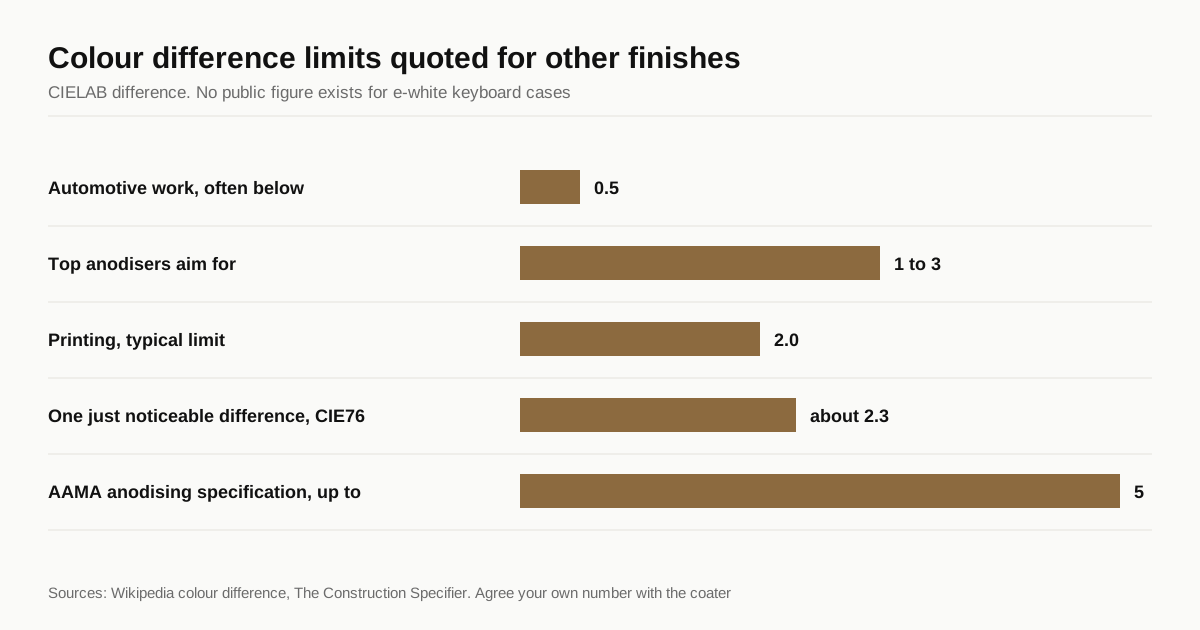
Tolerance. Wikipedia’s colour difference article gives about 2.3 as one just noticeable difference in CIE76, and shows how different industries set different limits, with printing typically at 2.0 and some automotive work below 0.5. An anodising guide in The Construction Specifier reports that the AAMA specification allows up to 5 and that top anodisers aim for 1 to 3. Those numbers describe other finishes. There is no public figure for e-white cases, so ask the coater what it can hold on one lot and write that number on the order. A tolerance tighter than the coater can hold is either priced in or refused.
Yellowness check. For a white, record the b* value of the master. A positive shift in b* is a move towards yellow, which is the drift people notice first.
Lot rule. Every part that sits together, including the case, weight and any accent, should come from the same lot and the same bake. The anodising relationship that repeats colour makes the same point from the shop’s side.
Check the white where it will be used
A measurement settles the case against the master. It does not settle the case against the keycaps.
- Put the case beside the keycaps and the other parts, not on a white bench.
- View them under daylight and under warm indoor light, because near-neutral colours are the most likely to disagree.
- Decide which part is the target. If the keycaps are fixed, ask the coater to aim at them. If the case is fixed, choose keycaps afterwards.
- Look at edges and corners. An opaque film hides a lot, but a chip shows the grey metal under it most clearly on a white surface.
Write the result into the cosmetic standard and the copy-and-paste cosmetic standard so the inspector has numbers and a master, not an opinion.
A short specification
Put these lines on the drawing or order:
- Finish: electrophoretic coating, white, with the coating system named by the coater.
- Master sample: part number, who holds it and the CIELAB reading with illuminant, observer and formula.
- Tolerance: maximum colour difference to the master, and maximum difference between parts in one lot.
- Lot rule: all matching parts in one coating lot and one bake.
- Surface before coating: blast, brush or polish, with the grade.
- Thickness: the range the coater agrees to hold, because it also affects fits.
- Rejects: who pays, using the scrap and overage rule agreed beforehand.
To compare shops that run coated whites on a drawing, send the files through the RFQ form. We match the request with up to 3 shops and reply within 24 business hours.
Sources
- Wikipedia, anodizing (dyeing and colour range)
- Wikipedia, electrophoretic deposition
- Wikipedia, colour difference (CIELAB and just noticeable difference)
- Wikipedia, metamerism (colour)
- X-Rite, whiteness and yellowness indices (ASTM E313)
- The Construction Specifier, avoiding colour variation in anodised finishes
- MaxGaming, KBDfans KBD67 V3 case listed as E-White (retail listing)
- Mode Designs, SixtyFive bottom case listing with electrophoresis-coated white
No public tolerance standard exists for e-white keyboard cases. Agree a measured target with your coater in writing.
Frequently asked questions
What does E-White mean on a keyboard case?
E-white is the keyboard community's name for a white finish applied by electrophoretic coating, or e-coat. Retail listings use E-White as a colour name, and at least one maker labels its white option as electrophoresis-coated aluminium. It is an opaque film on the surface, not a dyed anodised layer.
Why can't anodising produce a true white?
Anodised colour comes from dye held in the pores of a thin oxide layer. Wikipedia's anodizing article says white cannot be applied this way because the dye molecules are larger than the pores. The layer is also translucent, so the metal shows through. That is why white cases are e-coated or painted instead.
How closely can two e-white cases match?
No public tolerance standard exists for e-white keyboard cases, so the answer depends on the coater and on how you measure. A difference of about 2.3 in CIELAB is roughly one just noticeable difference. Ask the coater what difference it can hold on one lot and write that number into the order.
Will an e-white case match white keycaps?
Not exactly. A coated metal case and a moulded plastic keycap are different materials with different surfaces, so their whites will not be identical, and a match under one light can fail under another. Decide which part is the target, and check both together under daylight and warm indoor light.
Need a quote for your case?
Send the files. We match you with up to 3 shops that machine keyboard cases and reply within 24 business hours.
Get matched with a keyboard case shop