Guides / Materials
Case Foam for Keyboards: Poron, Silicone and PE Compared
October 16, 2026
Foam is the cheapest and most overlooked material in a keyboard. A case, a plate and a PCB get most of the attention, then a few cents of sheet is added between them, and it ends up in the design discussion as a sound mod. For a designer or a group buy runner it is also a manufacturing item with its own supplier, tolerances and surprises.
This guide covers the three families you will meet, how they compare and what to specify so the foam you receive matches the foam you tested.
Where foam goes in a keyboard
A board can use foam in several places, and each place wants slightly different properties.
- Case foam. A thick sheet in the bottom of the case, under the PCB. It fills the empty space and adds damping.
- Plate foam. A thin sheet between the plate and the PCB, or between the plate and the switches.
- PCB or switch pad foam. A thin layer under the PCB that sits against the switch pins or the case.
- Gasket strips. Foam strips that carry the plate in a gasket mount design. These are the most critical and the most demanding of the three. See the gasket mount guide.
Because the roles differ, there is no single best foam. A material that makes a good thin plate foam may be too stiff for a gasket and too thin for a bottom case layer.
The three families
Microcellular polyurethane. Often sold under a brand name that has become a generic term, this is a fine cell, open or semi-open foam with a low compression set. It returns to its original thickness after being squeezed and is firm for its density. It is common for gaskets and plate foam.
Silicone foam. A soft, spongy foam that can be squeezed far and tolerates high and low temperatures well. It is gentle on the PCB and common in gasket and bottom case use. It is typically more expensive than polyethylene.
Polyethylene (PE) foam. Closed cell foam in many grades. Cross-linked PE is firm and thin and often used as switch pad foam. Plain PE is cheap and stiff. It compresses less than silicone and recovers fully only within a modest squeeze.
Other materials turn up too, such as EVA, neoprene and EPDM foams. They fit the same framework, and a data sheet will tell you which family they behave like.
How they compare
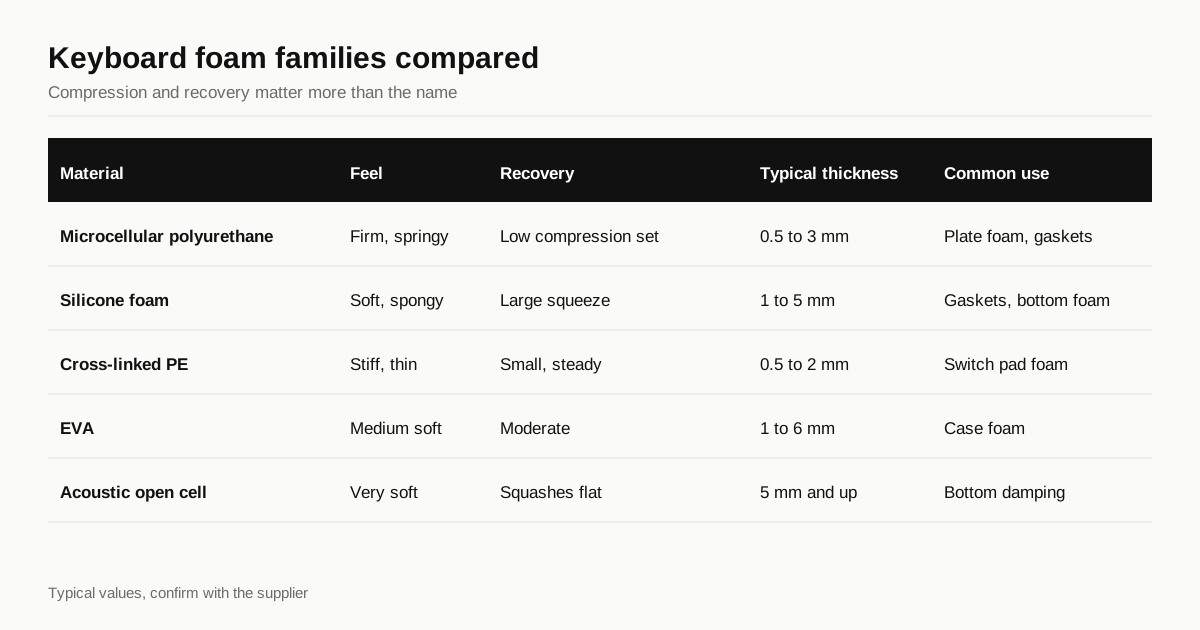
| Material | Feel | Compression behaviour | Typical thickness | Common use | Notes |
|---|---|---|---|---|---|
| Microcellular polyurethane | Firm, springy | Low compression set, recovers well | 0.5 to 3 mm | Plate foam, gaskets | Widely used, grades vary |
| Silicone foam | Soft, spongy | Large squeeze, recovers slowly in some grades | 1 to 5 mm | Gaskets, bottom foam | Handles heat well |
| Cross-linked PE | Stiff, thin | Small compression, steady | 0.5 to 2 mm | Switch pad foam | Cheap, widely stocked |
| Plain PE | Stiff | Limited recovery | 1 to 10 mm | Packaging, cheap case foam | Compresses permanently |
| EVA | Medium soft | Moderate recovery | 1 to 6 mm | Case foam | Can be cut cleanly |
| Acoustic open cell | Very soft | Squashes flat | 5 mm and up | Bottom case damping | Little structure |
These are typical ranges and grades differ, so check the maker’s data sheet. The figures that matter are compression force, which tells you how hard the foam pushes back at a given squeeze, and compression set, which tells you how much of the squeeze stays after the load comes off.
Compression and why it matters
Foam works by being compressed. A case foam that is the right thickness for its pocket is squeezed a little when the case is closed. A foam that is too thick pushes on the PCB and can bow it or lift it off its supports. A foam that is too thin does nothing.
Most gasket foams are used at moderate compression, often somewhere between 10 and 30 percent of their thickness, though the right figure comes from the maker’s data. The same sheet behaves differently at different squeezes, and much more stiffly near its limit.
Compression set is the quiet failure mode. A foam that stays partly squashed after months in a case loses its spring, and the board feels different from the one that was approved. Low-set materials are worth their cost for gaskets that carry a plate for years.
Thickness, tolerance and the case pocket
Foam thickness varies. A sheet sold as 2 mm can measure noticeably more or less across a roll and between batches, a tolerance of plus or minus ten percent or wider being common.
That matters for a machined case in two ways:
- Pocket depth. If the case pocket is cut to the nominal foam thickness, a thick batch will overload the PCB and a thin batch will leave it loose.
- Gasket shelf depth. On a gasket mount case the shelf sets compression, and a foam tolerance stacks on top of the machining tolerance.
The cure is to design for the real foam. Measure sheets from the batch you will buy, set the pocket to suit and put the foam and the machined part in the same prototype. The prototype guide explains why a sample with every part, foam included, is worth building.
Cutting foam
Foam is cut by a different route from the case, usually by a different supplier.
- Die cutting. A steel rule die stamps out a shape. It is fast and cheap at volume, with a one-off tooling cost.
- Knife plotter. A computer-driven blade cuts without tooling. It suits runs of dozens to hundreds.
- Laser cutting. Fast and flexible, but some foams scorch or release fumes, so the foam type matters.
- Waterjet. Handles thick foam, with more cleanup.
Cut tolerance is looser than metal. About 0.3 mm is a typical working figure, and sharp internal corners round off, so draw a small radius into the outline. If a pocket in the case is machined to a close fit, make the foam slightly smaller than the pocket so it never has to be forced in.
Comparing foams fairly
Because foam is cheap, it is tempting to test it by swapping sheets in one board and listening. That is a good start, and it fools people unless the test is controlled.
- Change one thing at a time. Swap the foam and nothing else. A change of keycaps, switches or lubricant in the same session makes the result meaningless.
- Keep the squeeze the same. A foam that is thicker or thinner changes the compression, and the compression changes the feel. Compare at equal compression.
- Listen after the foam has settled. Fresh foam springs back more than foam that has been under load for a day or two.
- Record the exact sheet. Note the maker, the grade and the thickness, so the same material can be ordered again.
- Build a second sample. One board can differ from another for reasons unrelated to foam, and a repeat check keeps you from choosing on noise.
The same discipline applies when a case design depends on the foam. Approve a sample with the real foam fitted, and write the grade and thickness into the specification so the production run uses the same one. Without that, a substitute sheet arrives with a different feel and nobody can say what changed.
Adhesive backing
Many foams come with a pressure-sensitive adhesive on one side, which holds the foam in place during assembly. It helps and it can hurt.
- Residue. A strong adhesive can leave marks on an anodised surface when the foam is removed.
- Edge lift. A weak adhesive lets the corners curl up, which shows in a gasket.
- Surface preparation. Oil on the surface, including the oil left from machining, stops the adhesive from holding. The case must be clean before the foam goes in.
If buyers are meant to open the case, ask whether the foam is loose, taped or glued, and pick one the buyer can remove cleanly.
Sourcing foam for a run
Foam is usually a separate item from the case, and it needs the same planning as any other part.
- Quantity. A group buy needs a set of foams per board plus a margin for spoilage.
- Minimums. Some suppliers sell only full sheets or rolls, which is far more foam than a small run needs.
- Lead time. Cut foam can take a week or more, particularly for a die.
- Kitting. Foam is bagged with the case or shipped separately, and that choice changes packaging and freight.
Writing foam into the RFQ with a thickness, a material family and a quantity avoids a surprise later, and it is covered in the RFQ template.
Before you order
- Material family and maker’s data sheet chosen
- Thickness measured on real sheets, with the tolerance noted
- Pocket depth and gasket shelf set from the real thickness
- Cutting method and tolerance agreed
- Adhesive type and removal checked on a finished surface
- Quantity set with a margin and a lead time
Foam sits beside the metals in our guide to keyboard case materials.
If foam is part of your design, send the files through the RFQ form and we will match them with shops that can advise on the case side of the stack.
Frequently asked questions
What is the difference between Poron and silicone foam in a keyboard?
Poron is a microcellular polyurethane with low compression set, so it recovers well and is common for gaskets and plate foam. Silicone foam is softer and spongier, takes a larger squeeze and tolerates heat. The feel and the cost differ, and both depend on the grade.
How thick should case foam be?
It depends on the gap it fills and the compression the design expects. Plate and PCB foams are often between 0.5 and 3 mm, and bottom case foam is thicker. Design the foam pocket around the real sheet you will buy, since thickness varies.
Can foam change how a keyboard sounds?
It changes it, mostly by damping some frequencies, but the effect is small compared with mounting style, plate and keycaps. Treat sound claims with caution and compare in a built sample, not on a spec sheet.
Need a quote for your case?
Send the files. We match you with up to 3 shops that machine keyboard cases and reply within 24 business hours.
Get matched with a keyboard case shop