Guides / Materials
Wood Keyboard Cases and Wood-Aluminium Hybrid Builds
October 27, 2026
A wood keyboard case is a different object from a machined aluminium one. It is warmer to the touch, it looks different from every angle and no two cases match exactly. It also moves, it takes a finish in a different way and it fails in ways that aluminium cannot.
None of that makes wood a bad choice. It makes it a choice that rewards a designer who knows how the material behaves. This guide covers species, movement, machining and finishing, and ends with the hybrid builds that put wood on top of a metal base.
Why wood is different
Aluminium is isotropic. It behaves the same in every direction, and its size is fixed to within a few hundredths of a millimetre at a given temperature. Wood is none of those things.
- It has a grain. Strength and behaviour differ along the grain and across it. A thin wall cut across the grain can snap where the same wall cut along the grain would hold.
- It moves with humidity. Wood takes up and gives off moisture, and its size changes as it does. Movement is largest across the grain and small along it.
- Every piece is different. Colour, figure and density vary from board to board, so a set of cases cut from different boards will not match.
- It tears. A cutter can lift fibres out of the surface where the grain changes direction, leaving a rough patch.
All four have design and quote consequences, and they show up before the first case is cut.
Common species
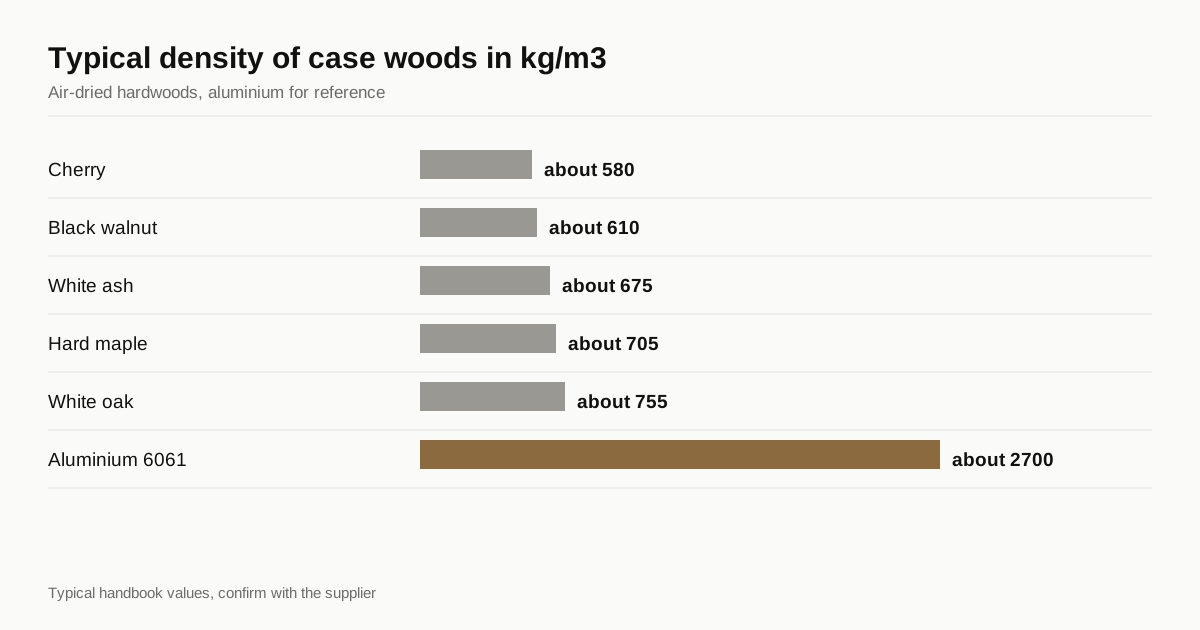
Hardwoods that are dense and close grained suit a keyboard case. The densities below are approximate for air-dried wood.
| Species | Density, about | Character | Notes |
|---|---|---|---|
| Black walnut | 610 kg/m³ | Dark brown, moderate hardness | Machines cleanly, takes oil well |
| Hard maple | 705 kg/m³ | Pale and hard | Dense, shows burning under a tool, takes a clear finish |
| Cherry | 580 kg/m³ | Pink to red, darkens with light | Machines easily, colour changes over months |
| White oak | 755 kg/m³ | Open grain, tan | Open pores need filler for a smooth surface |
| White ash | 675 kg/m³ | Pale with strong grain | Prominent figure, tears on poor tool paths |
Exotic and rare woods tempt designers. Some rosewoods and other species are covered by international trade controls such as CITES, which can require permits for export and import. If a design calls for a rare species, ask the shop for the species name, its legal source and any paperwork before you commit.
Stabilised wood, where resin is forced into the fibres under pressure, is a common choice for figured or burl material. It moves less and takes a finish evenly, at a higher price and with a harder cut.
Movement and what to do about it
A plain-sawn board can change its width by around one percent across a normal seasonal swing in humidity. Over a case depth of about 120 mm that is a movement of around a millimetre, which is easily enough to make a plate pocket tight or loose, open a gap between a wood part and an aluminium one or put a load on a screw.
Four design habits keep movement under control:
- Run the grain along the long axis of the case. Movement is across the grain, so the length stays stable and the depth moves.
- Leave clearance in the plate pocket. Where a rigid plate sits in a wooden pocket, allow more clearance than you would in metal.
- Use slotted or oversize holes where a wood part is screwed to a metal part, so it can move without cracking.
- Seal every surface. Finish the inside and the underside as well as the top. A one sided finish makes the board take up moisture unevenly and cup.
Kiln dried stock at a controlled moisture content, stored in the shop for a few days before cutting, is also much more stable. Ask the shop what moisture content they work to and how they store stock.
Machining wood for a case
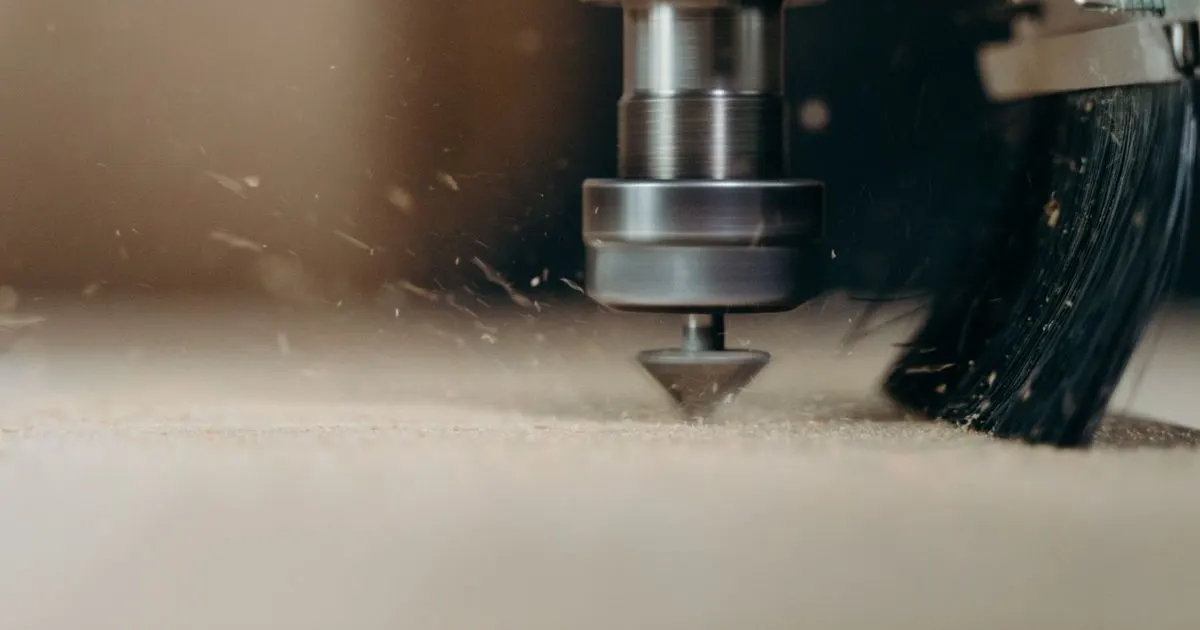
Wood is cut on a router or a mill with tools made for it, and the cut itself is quick. The careful parts are the details.
- Grain direction. A cutter moving with the grain leaves a clean surface. One moving against it can tear. A good path plan uses climb cuts and a final light pass.
- Compression cutters. An upcut and downcut spiral pushes fibres from both sides and leaves a clean edge on both faces of a sheet.
- Thin walls. Across the grain they break, and a wall under about 3 mm is risky in solid wood.
- Sharp tools. A dull cutter burns hard maple and leaves a dark scorch that is hard to sand out.
- Dust. A shop that handles wood needs extraction, and the dust is a hazard. It is also a reason some metal shops will not take wood work.
- Holding. Clamping marks on a finished face show, and soft wood dents under a vise.
Tolerances are looser than for metal. A plus or minus 0.2 to 0.3 mm tolerance is typical for wood parts, and the true figure depends on the moisture and the stability of the stock. Drawing a block tolerance of 0.05 mm on a wooden case asks for something the material will not hold. The tolerances guide helps decide which features need a tight number at all.
Fasteners in wood
A screw cut directly into wood works for a prototype and pulls out with repeated use. Production cases use a better method.
- Threaded inserts. A brass or steel insert screwed or pressed into a drilled hole gives a machine thread in the wood and takes repeated assembly.
- Through holes with nuts. A bolt passing through the wood into a nut on the other side is strong and serviceable.
- Metal brackets. In a hybrid, the screw threads go into the aluminium part, not the wood.
Keep hole edges at least a few millimetres from the wood’s edge, particularly across the grain, where the wood splits easily. More on thread choices is in screw inserts and tapped holes.
Finishing wood
Wood takes finishes that aluminium does not, and finishing is where most of the look comes from.
- Oil or hard wax oil. Soaks in and leaves a natural surface that can be refreshed. It protects moderately and is the common choice for walnut.
- Lacquer or polyurethane. Builds a harder film that resists wear and moisture better, with a more glossy or satin look.
- Stain. Changes colour but can look blotchy on maple and cherry.
- Sanding. Each finish needs a graded sanding sequence, and the final grit changes the look.
The finish also controls movement by slowing moisture exchange. A finish applied to every face, including the inside, keeps the case stable. Ask the shop who finishes the wood, since many machine shops cut it and send it out, adding a vendor and a schedule risk just as a second vendor does for PVD or Cerakote.
Hybrid builds
A hybrid joins wood with another material. The aluminium and wood case is the most common.
| Build | What it gives | What to watch |
|---|---|---|
| Wood top, aluminium bottom | Wood look, aluminium weight and flat base | Join must allow for wood movement |
| Aluminium frame, wood side panels | Metal rigidity, visible wood sides | Panel fit and a gap that moves |
| Wood case, metal weight | Warm look, weight where it is needed | Weight fixing in wood needs inserts |
| Stacked layers of wood and metal | Layered look, flexible build | Many surfaces and many fits |
The wood top and aluminium bottom is the practical default. The metal base provides a flat reference, a place for threads and the weight a wooden case lacks, while the wood supplies the look. Colour match is not a concern, since the two materials are different on purpose.
The part that deserves attention is the joint between them. The wood will move, and the aluminium will not. Use screws in slotted holes or in oversized holes with a washer, and keep the gap between the parts planned, since it will open and close with the weather.
Lead time and the supply chain
A wood case runs on a different supply chain from an aluminium one. Stock must be selected and dried, the cutting happens on a router, the finishing is often by hand and the metal parts are machined and anodised separately. That is three or more processes running in parallel, which should be reflected in the lead time and in who owns the schedule.
Before you order
- Species named, with source and paperwork for any restricted wood
- Grain direction shown on the drawing
- Clearance for movement in plate pockets and joints
- Inserts or through bolts at the fixing points
- Finish specified, covering all surfaces
- Tolerances set for wood, not for metal
Wood and hybrid builds are one part of our guide to keyboard case materials.
If you are planning a wood or hybrid run, send the files through the RFQ form and we will match them with shops that work in wood as well as metal.
Frequently asked questions
Does a wood keyboard case warp?
Wood moves as humidity changes, mostly across the grain, and a case that is not designed for it can twist, crack at a screw or open a gap against a metal part. Kiln dried stock, stable species, a sealed finish and slotted or oversized fixing holes reduce the risk a lot.
What is the best wood for a keyboard case?
Dense, close grained hardwoods such as walnut, maple, cherry and oak are the common choices. Walnut machines well and shows its grain under oil. Maple is hard and pale. Oak is open grained and needs filler for a smooth finish.
Can I combine a wood top with an aluminium bottom?
Yes, and it is the most common hybrid. The aluminium base gives weight and a flat reference and the wood gives the look. The join needs to allow for the wood to move without loading the screws.
Need a quote for your case?
Send the files. We match you with up to 3 shops that machine keyboard cases and reply within 24 business hours.
Get matched with a keyboard case shop