Guides / Materials
7075 Aluminium for Keyboard Cases: Is It Worth the Extra Cost?
October 5, 2026
Walk through any keyboard group buy and you will find a line that reads “7075 aluminium”. It sounds like an upgrade, and in aerospace terms it is one. Whether it is an upgrade for a keyboard case is a different question, and the honest answer is that it depends on what you are trying to fix.
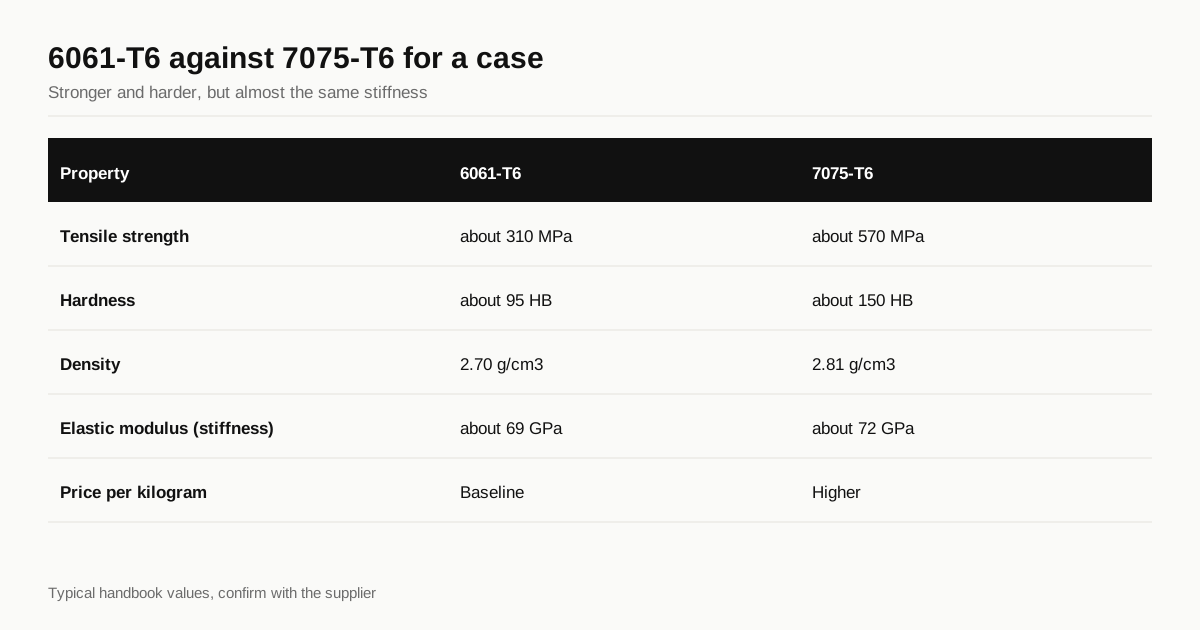
This guide compares the two alloys on the properties that matter for a case, and ends with a short rule for when 7075 is worth paying for.
What 7075 is
7075 is an aluminium alloy with zinc as the main alloying element, plus smaller amounts of magnesium and copper. It is a high strength alloy used in aircraft structures and in high end sporting goods. It is usually supplied in the T6 temper, which is heat treated and artificially aged for peak strength.
6061 is the common general purpose alloy. It contains magnesium and silicon, machines well, anodises cleanly and costs less. For most cosmetic aluminium work it is the default, and the choice is covered in more detail in the 6061 versus 6063 guide.
Plate in both alloys is commonly sold against standards such as ASTM B209 for sheet and plate, and aerospace specifications such as AMS 4027 for 6061-T6 and AMS 4045 for 7075-T6. Those describe the stock. They are not a promise from any shop about the finished case.
The numbers that matter
These are typical handbook values for the T6 temper. They vary a little by product form and supplier.
| Property | 6061-T6 | 7075-T6 | What it means for a case |
|---|---|---|---|
| Tensile strength | about 310 MPa | about 570 MPa | 7075 resists bending and breaking much better |
| Yield strength | about 275 MPa | about 500 MPa | 7075 dents and bends permanently at a higher load |
| Hardness | about 95 HB | about 150 HB | 7075 scratches and wears less |
| Density | 2.70 g/cm³ | 2.81 g/cm³ | 7075 is about 4 percent heavier |
| Elastic modulus | about 69 GPa | about 72 GPa | Almost the same stiffness |
| Thermal conductivity | about 167 W/m·K | about 130 W/m·K | Both feel cool to the touch |
| Price per kilogram | baseline | higher | Quotes show the difference |
| Corrosion resistance | good | lower, relies on anodising | Anodised cases are protected |
The row that deserves attention is the elastic modulus. Stiffness comes from the modulus and the geometry, not from strength. A 7075 case flexes almost exactly as much as a 6061 case of the same shape. It does not resist twisting or bending noticeably better in normal use, because a keyboard case never operates anywhere near the stress where the difference in strength matters.
Where the extra strength helps
7075 earns its premium in specific places, all of them about local damage and wear, not overall rigidity.
- Thin walls and edges. A wall under about 1.5 mm, or a sharp lip, bends or dents less in a drop.
- Scratches and wear. Higher hardness resists scuffs from desks, bags and keycap pullers.
- Threads. A tapped thread in a harder alloy lasts more rebuild cycles before it wears. See screw inserts and tapped holes for the alternatives.
- Small features. Fine ribs, tabs and snap features keep their shape.
- Marketing. For a premium product, “7075” on the specification sheet is a recognised signal.
If your case is a thick block with a wide bezel and plenty of material around the screws, none of these apply strongly.
Where it does not help
Three claims show up in group buy pages and deserve caution.
“It is stiffer.” It is not, as the modulus row shows. A case that flexes under a thumb press flexes the same in both alloys. The cure is geometry: a thicker wall, a rib or a better support layout.
“It sounds better.” A keyboard’s sound is shaped by the mounting style, the plate, the foam, the keycaps and the switch. The case alloy is one small variable among many, and the difference between 6061 and 7075 is far below what a listener can reliably tell. The mounting styles guide explains what actually shapes the sound.
“It is lighter.” It is slightly heavier. Anyone who says otherwise is comparing it with a thicker 6061 design.
The anodising difference
The alloy changes how the anodise looks. The zinc and copper that give 7075 its strength also change how the oxide layer forms and takes dye.
- Clear and light shades. 7075 can show a slight tint or dullness compared with 6061, often a faint yellow or grey cast.
- Dark colours. Black and deep colours hide most differences, but shade match across batches can be harder to hold.
- Mixed parts. If a case in 7075 is sold with a 6061 plate or weights in the same colour, the two will not match perfectly.
The practical rule is to anodise a sample in your chosen alloy and colour before ordering, not to assume the swatch from a 6061 part applies. The colour matching guide explains how to approve and keep a golden sample.
What 7075 adds to the quote
The cost is a mix of material and machining.
- Material. The price per kilogram is higher than 6061, and 7075 plate is sometimes harder to find in large thicknesses. A case starts as a block with most of it removed, so the extra material price applies to the whole block, not only to the finished part.
- Machining. It cuts well and gives a good surface, but it can wear tools somewhat faster and break chips differently, so shops may price slightly higher.
- Scrap. If the shop has not machined 7075 cases before, it may add risk to the overage.
Expect the quote to rise by a noticeable margin and not a trivial one. The cost breakdown in what a machined case actually costs shows why the alloy is only one line among several, and why quantity and setups often move a quote more than the alloy does.
How to run a fair comparison
Asking for two quotes only helps if the quotes are comparable. A few habits keep the comparison honest.
- Give both shops the same model, quantity and finish. If one quote includes a different anodise route or a different overage, the alloy gets the blame for a gap that came from somewhere else.
- Ask for the material line separately. The block price is the clearest view of what the alloy itself costs, and it moves with the market. A shop can tell you the date the price was taken.
- Ask whether the plate is the same temper and thickness. A thicker block of one alloy raises the price for reasons that have nothing to do with the alloy name.
- Ask for a repeat price. If you plan a second run, the number that matters is the cost with tooling already paid for.
You can also ask each shop what they would change in the design if you chose the stronger alloy. A good answer is “nothing”, because the geometry is already sound. A better answer is a suggestion to thin a wall you did not need to keep thick, which lowers the weight and the machining time and can pay back part of the material premium. That kind of reply comes only from a shop that has made the part before, and it is worth more than the last few percent on the price.
A simple rule for choosing
Choose 6061 when:
- the walls are 2 mm or thicker everywhere
- the case will be opened a normal number of times
- the price matters and the colour is a standard anodise
- you want the lowest risk on colour matching
Choose 7075 when:
- the design has thin walls, sharp lips or fine features
- the buyers will rebuild the board often and thread wear matters
- the product is positioned as a premium item and the price supports it
- you have confirmed anodise samples in 7075 and approved them
If you are unsure, ask two shops to quote both alloys on the same model. The difference in price is the real figure, and you can decide whether the marketing line is worth it.
Questions for a shop
- Have you machined and anodised 7075 keyboard cases before?
- Which supplier and standard is your plate from, and is it the T6 temper?
- Does the quote change with alloy, and by how much?
- Will you anodise a sample in 7075 in my colour before the run?
- Does the scrap allowance change?
Before you order
- The reason for 7075 written down: walls, wear, threads or positioning
- A quote for 6061 alongside it
- Anodise sample approved on the actual alloy
- Alloy and temper stated on the drawing
- Mixed alloy parts checked for colour match
For the other metals and plastics beside 7075, see our guide to keyboard case materials.
When you are ready to compare, send the files through the RFQ form and ask for both alloys. We will match you with shops that machine both regularly.
Frequently asked questions
Is 7075 better than 6061 for a keyboard case?
It is stronger and harder, which helps with scratch and dent resistance and with thread wear, but it is not noticeably stiffer. For most cases 6061 does the job and costs less, so 7075 is a choice about durability and marketing, not performance.
Does 7075 sound different from 6061?
Claims that 7075 sounds better are usually marketing. Stiffness is almost the same in both alloys, and the sound of a keyboard is dominated by mounting style, plate, foam and keycaps, not by which aluminium alloy the case is.
Can 7075 be anodised in the same colours as 6061?
Yes, but the same dye can look slightly different on 7075, often a little duller or with a tint in light shades. If a set of parts mixes alloys, ask the anodiser to match them on samples before the run.
Need a quote for your case?
Send the files. We match you with up to 3 shops that machine keyboard cases and reply within 24 business hours.
Get matched with a keyboard case shop