Guides / Finishing
Diamond Cut Edges on a Keyboard Case: What They Cost
October 14, 2026
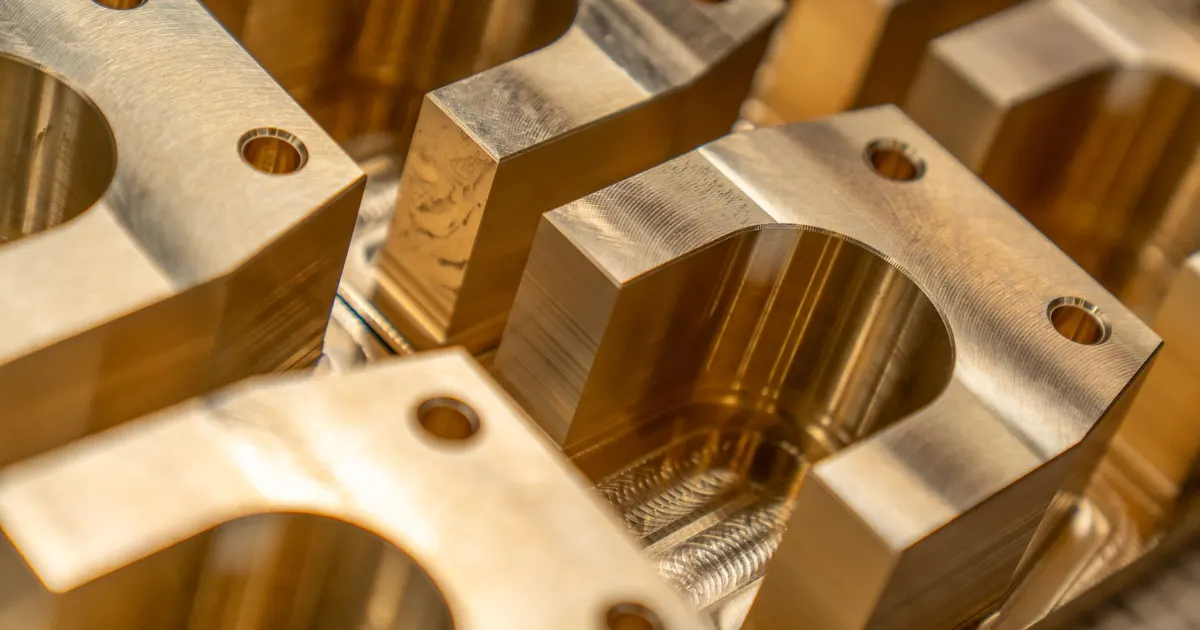
Look at a premium aluminium laptop or phone and you will usually find a thin bright line along the edge, where a matte body meets a mirror finish. That line is a diamond cut chamfer, and designers of keyboard cases have borrowed it. It is a lovely detail, it is also one of the easiest ways to add cost, schedule risk and scrap to a run, and few designers know that before the quote arrives.
This guide explains what the process is, where the cost comes from and how to ask for it without surprises.
What a diamond cut chamfer is
A chamfer is a small bevel along an edge. A normal machined chamfer is cut with a regular carbide tool and leaves a surface with fine tool marks, which a blast or anodise then dulls into the same matte look as the faces next to it.
A diamond cut chamfer is made by a different tool. A diamond cutter, either a single crystal diamond or a polycrystalline diamond insert, runs at high spindle speed and shears a clean, very smooth surface. The surface is smooth enough that it reflects light like a mirror. Aluminium and brass are the common materials because diamond tooling cuts them well, while steel and titanium are poor candidates for it.
The effect depends on contrast. A bright narrow facet next to a bead blasted face reads as a crisp highlight, and a bright facet next to another polished surface does not. This is why designers who want the look also specify a blast on the faces.
Where it sits in the process
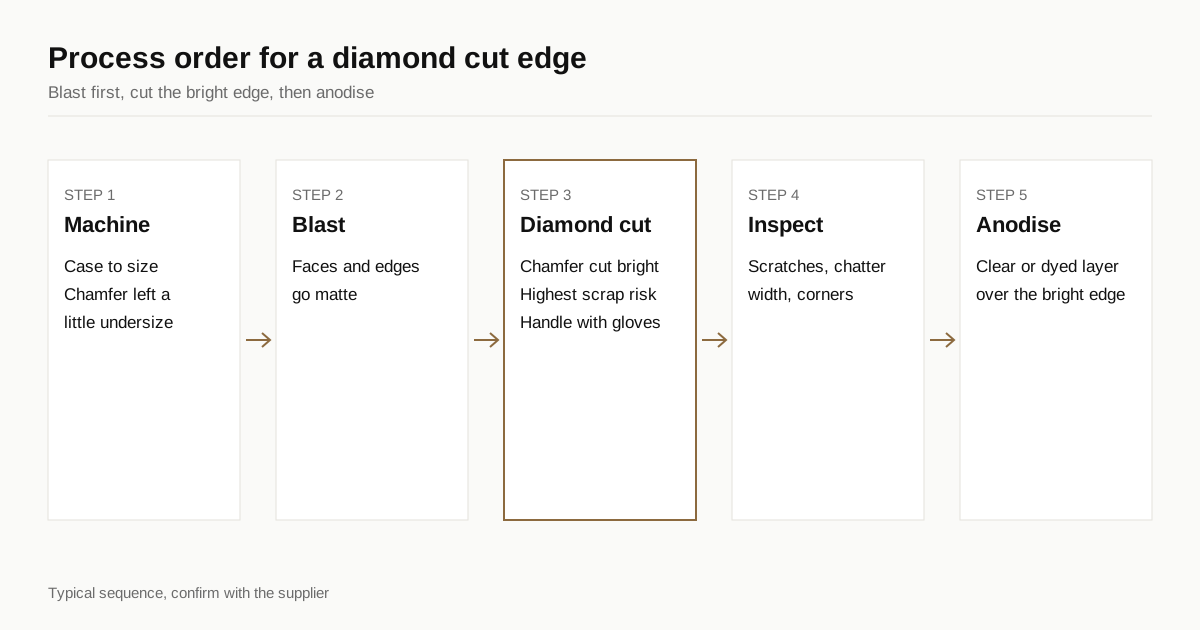
The usual order is:
- Machine the case to size, with the chamfer left a little undersize or cut as a normal chamfer.
- Blast the faces, which dulls everything including the chamfer.
- Diamond cut the chamfer, which removes the blasted skin on the bevel and leaves it bright.
- Clean and inspect. Fingerprints and chips matter now.
- Anodise. A thin transparent layer protects the surface and may add colour.
Doing the diamond cut before the blast would leave a bright chamfer that the blast dulls again. Doing it after anodising would cut through the coloured layer and leave bare metal on the edge. Neither is wrong, but they are different looks, and the shop should know which one you mean.
What it adds to the cost
Five things make a diamond cut edge more expensive than a plain chamfer.
| Cost item | What it is | Typical effect |
|---|---|---|
| Extra operation | Another setup or machine pass after blasting | Adds handling and machine time |
| Special tool | Diamond cutters are expensive and wear slowly | Charged into the part price |
| Specialist machine time | A fast spindle and a rigid machine | Not every shop has one |
| Handling | Gloves, soft fixtures and clean surfaces | Slower and more careful |
| Scrap allowance | A visible bright edge with no recovery | Higher overage |
The first four are one-time or per-part costs. The fifth is the one that surprises people, and it is the most useful to understand.
Why scrap is higher
A bright chamfer shows defects that a blasted face hides. The ways it fails are:
- Scratches. A small scratch on a matte face disappears, but on a mirror facet it is the first thing the eye lands on.
- Chatter marks. If the tool vibrates, the surface shows fine ripples that read as haze or lines.
- Fingerprints and handling marks. The surface is bare until it is anodised, and an unprotected bright edge picks up marks easily.
- Width variation. A chamfer that varies by a few hundredths of a millimetre along its length looks like a wavy line.
- Corner defects. Where the chamfer turns a corner, the tool path changes direction and small errors show up.
Because anodising is not repairable, a defect found afterwards means scrapping the case and starting from raw stock. Shops that do this work routinely plan for it, and a quote that includes a diamond cut edge should include a higher overage than a plain blasted case. The principle is set out in pricing cosmetic scrap and overage, and the overage figure should be agreed in writing before you order.
How anodising changes the look
The anodise layer is transparent, so the bright facet still shows through. The colour of the dye shapes what you see.
- Clear or light silver. The facet stays a bright silver highlight, close to the look of the bare cut.
- Mid colours. The facet picks up the colour and stays glossy, so it reads as a brighter, richer version of the face.
- Black and deep colours. The facet becomes a glossy dark line. Some designers love this, and some find it loses the highlight they were hoping for.
The only reliable guide is a sample. Ask for a cut and anodised piece in your colour before approving the process, as you would for colour matching. The way dyes and finishes behave is covered in anodising keyboard cases.
Design choices that make it easier
You can reduce risk at the design stage without losing the look.
- Keep the chamfer simple. A constant width and a constant angle, usually 45 degrees, is easier to hold than a changing profile. Widths of about 0.3 to 1 mm are common.
- Round the corners. A small radius at corners gives the tool a path that does not stop and restart. A sharp corner is a likely defect.
- Avoid a diamond cut chamfer on a long edge that crosses a witness line. The step where two setups meet will show on a bright facet. The fixturing guide explains where those lines come from.
- Choose the alloy. 6061 cuts well. Softer alloys can smear, and harder ones are fine but wear tools faster. Check the alloy with the shop.
- Limit it to what shows. A bright edge on the top perimeter is enough for most designs. Doing every edge multiplies the risk.
How to write the spec
A workable diamond cut edge spec has five parts:
- Which edges. A drawing view that marks the chamfers, not a general statement.
- Width and angle. For example 0.5 mm at 45 degrees, with a tolerance in hundredths of a millimetre.
- Finish. “Diamond cut, bright, free of chatter and scratches at 400 mm under diffuse light.”
- Sequence. After blast and before anodise.
- Sample. An approved cut and anodised piece to compare each batch against.
The inspection distance and light conditions are the part people skip. The cosmetic standard template has a default you can copy. If you leave it vague, you will argue about what “flawless” means after the first parts arrive.
Handling between the cut and the tank
The weakest moment for a diamond cut edge is the gap between the cut and the anodising tank. The facet is bare aluminium with no protective layer, and a shop that handles it carelessly loses parts here, not at the machine.
Good practice is simple and worth asking about:
- Gloves and clean racks. Skin oils leave a mark in the anodise, and a rack that touches the facet leaves a contact point.
- No stacking. Cases that touch each other in a tray will scratch.
- Short gaps. The sooner the part goes from cut to tank, the less handling it sees. A shop that cuts one day and anodises a week later has more to lose.
- Protective film or bags on faces that do not need to be handled.
If the diamond cut is done by one vendor and the anodising by another, the case travels between them with a bright unprotected edge. That is a real risk, and it is one more reason to ask whether both steps happen under one roof.
When it is worth it
It is worth it when the edge is a defining feature of the design, the quantity is high enough to spread the cost and the shop has done the process before. It is not worth it on a tight budget, a short schedule or a first run with a new shop, where a plain chamfer with a good blast gives a very clean result at much lower risk.
A reasonable compromise is to quote both. Ask the shop for a price with a plain chamfer and a price with a diamond cut chamfer, so you can see the difference in money and schedule before deciding.
Before you order
- Edges marked on a drawing view with width and angle
- Sequence stated: blast, then diamond cut, then anodise
- Corner radii on the chamfer path
- Inspection distance and light written down
- Overage agreed for the higher scrap risk
- Both prices quoted, plain and diamond cut
When the design is settled, send the files through the RFQ form and we will match them with shops that run diamond cut chamfers on cosmetic aluminium.
Frequently asked questions
What is a diamond cut edge on a keyboard case?
It is a narrow bevel or chamfer along the edge of the case, cut at the end of machining with a diamond tool so that it comes out mirror bright. Against a bead blasted matte face it catches the light as a thin bright line.
Does anodising dull a diamond cut edge?
A clear or lightly dyed anodise keeps most of the brightness, while a deep dye gives a darker, glossier edge. The anodic layer adds a very thin film on top, so the surface must be clean and defect free before it goes into the tank.
Why do shops quote more scrap for diamond cut edges?
A bright facet shows every scratch, chatter mark and fingerprint at close range, and there is no later step that hides them. A small defect on a chamfer that would be invisible on a blasted face can fail the part.
Need a quote for your case?
Send the files. We match you with up to 3 shops that machine keyboard cases and reply within 24 business hours.
Get matched with a keyboard case shop