Guides / Materials
Aluminium Plate Stock for Keyboard Cases: Thickness and Sizing
October 11, 2026
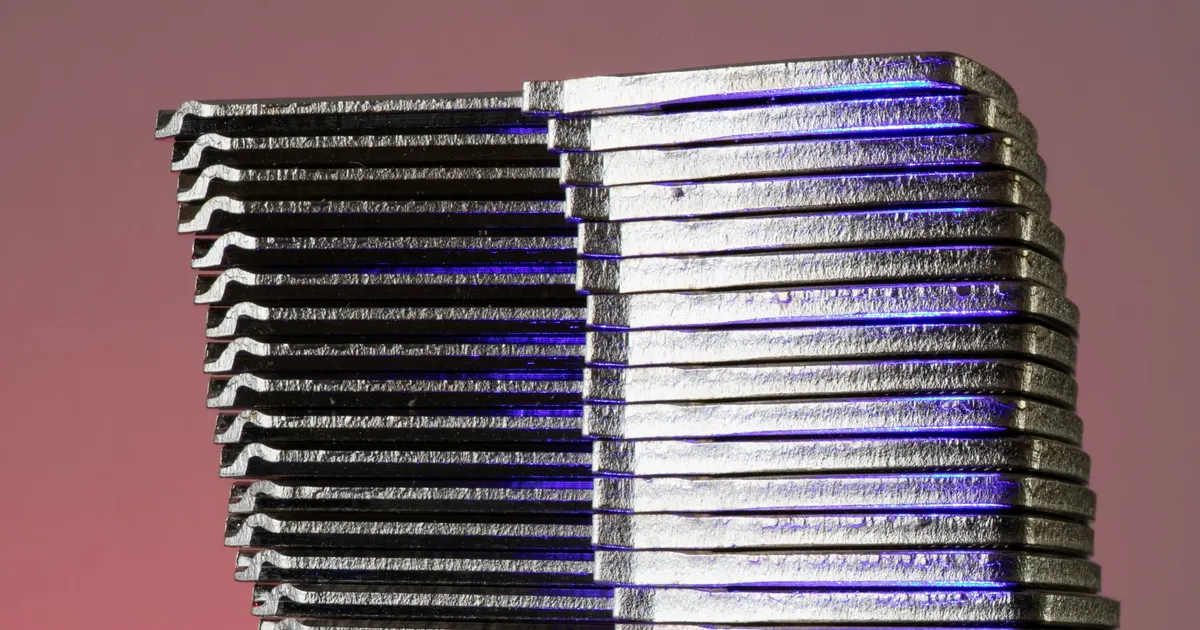
Every machined keyboard case starts as a rectangle of aluminium plate that is much larger than the finished part. The plate is bought in standard thicknesses and cut to a block, then most of it is turned into chips. The choice of plate decides how much material you pay for, whether the case stays flat after cutting and how well the anodise looks.
You do not have to buy the stock yourself. You should know how a shop sizes it, because the sizing is one of the few parts of a quote you can influence by changing the design by a millimetre or two.
What plate is
Plate is rolled aluminium sold in flat sheets, normally thicker than about 6 mm. It comes in a few forms, and the difference matters for a cosmetic case.
- Rolled plate in 6061. The standard choice. Common tempers are T6 and T651. The 51 in T651 means the plate has been stretched after heat treatment to relieve internal stress, which is exactly what a case needs.
- Cast tooling plate. A cast aluminium plate, often in a magnesium-rich alloy, made to be very flat and very low in stress. It is popular for jigs and fixtures. It is not designed for decorative anodising and can take a dye less evenly than 6061.
- Extruded flat bar. Aluminium pushed through a die to a rectangular section, usually in 6063 or 6061. It suits small cases and parts, with the shape close to final, but sizes are limited. The difference between the alloys is covered in the 6061 versus 6063 guide.
Plate is commonly bought against standards such as ASTM B209 for sheet and plate. The standard describes the stock, not the finished part or any promise from a shop.
Stock thickness steps
Plate comes in steps, not in every thickness, and the steps differ between metric and imperial markets.
| Metric plate | Nearest imperial plate | Imperial in mm |
|---|---|---|
| 10 mm | 3/8 in | 9.5 mm |
| 12 mm | 1/2 in | 12.7 mm |
| 20 mm | 3/4 in | 19.05 mm |
| 25 mm | 1 in | 25.4 mm |
| 30 mm | 1 1/4 in | 31.75 mm |
| 40 mm | 1 1/2 in | 38.1 mm |
| 50 mm | 2 in | 50.8 mm |
Which steps are in stock depends on the supplier and the region. Intermediate thicknesses can be ordered from a mill but usually with a minimum quantity, so most shops pick from what they can buy that week.
Sizing the block
The rule is simple. The finished height plus a machining allowance on each face gives the stock thickness, and the length and width get a smaller allowance for sawing and clamping.
- Facing allowance. Plate has a rough mill surface and a thickness tolerance. A shop usually removes about 1 to 2 mm from each machined face to reach a clean surface.
- Length and width allowance. About 5 mm per side is common, to allow for the saw kerf and a place to hold the block.
- Round up. The result is rounded to the next stock thickness the shop can buy.
A worked example. A top case with a finished height of 22 mm needs 22 plus about 1.5 on each face, which is 25 mm. A 25 mm plate fits with a small margin.
Now change the height to 24 mm. The requirement becomes 27 mm, so the next available plate is a step up, perhaps 30 mm, and several millimetres of metal are cut away for no reason. In a design where height is flexible, trimming 2 mm can save a whole plate step and noticeably reduce the cost. This is the same lever discussed in what a machined case costs: you pay for the block, not for the case.
Typical block sizes
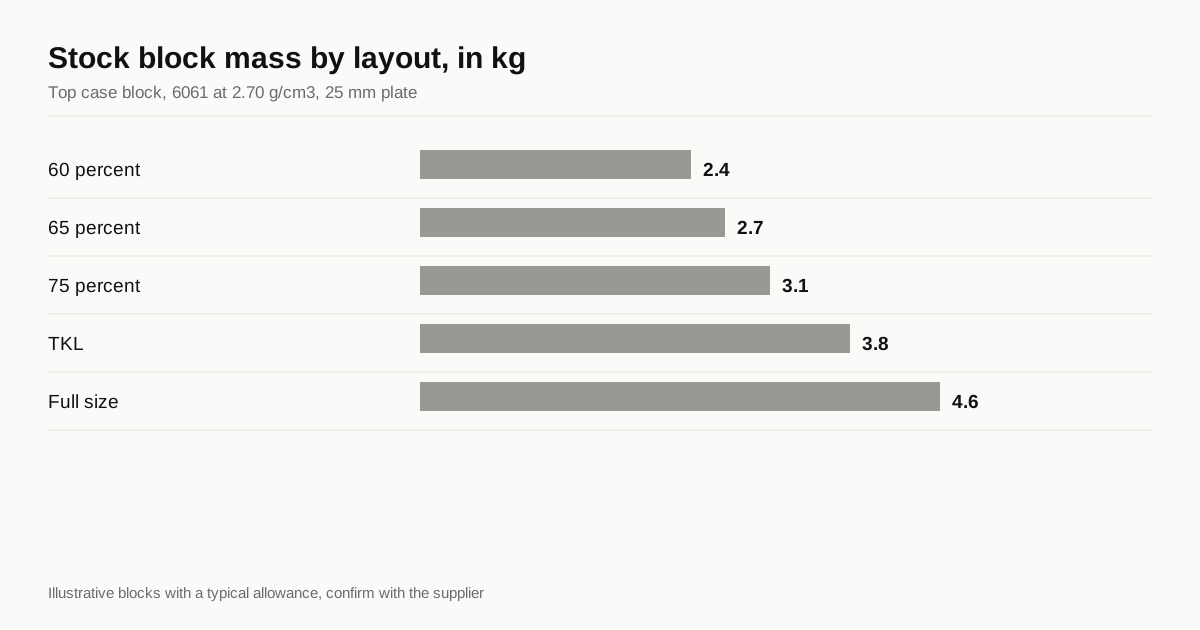
Here are illustrative top case blocks for common layouts. The finished sizes are typical, and the stock figures add about 10 mm to the length and width and a stock thickness of 25 mm. The mass is calculated at 2.70 g/cm³.
| Layout | Finished size, about | Stock block | Block mass |
|---|---|---|---|
| 60 percent | 295 x 105 x 22 mm | 305 x 115 x 25 mm | 2.4 kg |
| 65 percent | 320 x 110 x 22 mm | 330 x 120 x 25 mm | 2.7 kg |
| 75 percent | 330 x 125 x 22 mm | 340 x 135 x 25 mm | 3.1 kg |
| TKL | 365 x 140 x 22 mm | 375 x 150 x 25 mm | 3.8 kg |
| Full size | 440 x 140 x 22 mm | 450 x 150 x 25 mm | 4.6 kg |
A finished top case commonly weighs well under a kilogram, which shows how much of the block ends up as chips. A bottom case or weight is a separate block, and a taller design or a one piece case starts from a heavier one. The mass also drives the quote. More mass means more raw material and more cutting time, which is why the larger layouts cost more than their size suggests. The layout comparisons are in machining a 65 percent case and TKL against full size.
Stress and bowing
Rolled plate holds internal stress from the rolling and cooling process. When a shop cuts a deep pocket into one side, the material that held the stress is removed unevenly and the remaining part can bend, sometimes by a few tenths of a millimetre across a case. The result is a case that rocks on a desk and a plate pocket that no longer sits flat.
Defences are well known:
- Stress relieved plate. T651 and similar tempers carry much less stress than plain T6.
- Rough, rest, finish. The shop removes most of the material, leaves the part for a while to move and then takes the finishing cuts.
- Balanced removal. Cutting from both sides, flipping the part between passes, spreads the stress release.
- Leave stock on critical faces until the end, so that the final cut flattens whatever movement occurred.
Ask a shop whether it uses stress relieved plate and how it handles deep pockets. A confident answer about roughing and resting is a good sign. The check at the other end is in inspecting a keyboard case, where flatness and rock are measured.
Splitting a tall case to save material
A tall case cut from one block wastes a lot of metal, because the stock thickness has to cover the full height. Designers can cut that waste by splitting the case into parts.
- Top and bottom from separate plates. A shallow top and a shallow bottom each start from a thinner plate, and the combined mass of the two blocks is often lower than one tall block.
- A layered case. Two or three flat layers, each from thin plate, are stacked and screwed together. The cost is more joins and more surfaces that must line up, so it is a good fit for designs that already show the layers as a feature.
- A bottom case as a weight. If a brass or steel weight already forms the base, the aluminium part can be shorter.
Each option trades material for extra setups, joins and parts, so the saving is not automatic. Ask a shop to quote the single block and the split version on the same model, and compare the totals instead of the plate price alone. The same trade-off between setups and material runs through the five axis versus three axis guide.
Anodising and plate quality
Plate quality shows up after anodising. Inclusions, streaks from the rolling direction and areas of different grain can show as faint lines or patches in the colour, especially under a dark dye. Good suppliers and a clean 6061 plate give a uniform result, while surplus or unknown stock is a risk.
Use plate from a known supplier and keep one lot together for a run. If two lots go into one batch, their anodise can differ slightly. The anodising guide explains how the alloy affects the finish.
Questions for a shop
- Which alloy and temper do you plan to use, and is the plate stress relieved?
- Which thickness will you buy, and what allowance does that leave?
- Does the whole run come from one lot of plate?
- What is the block mass, and what is the material price per kilogram?
- How do you handle bowing on deep pockets?
Before you order
- Finished height known, with the next plate step in mind
- Alloy and temper stated: 6061-T651 or equivalent
- One lot of plate for the whole run
- Stress relief and roughing method discussed
- Material priced as its own line
Plate stock is one part of our guide to keyboard case materials.
When the design is ready, send the files through the RFQ form and we will match them with shops that stock and size plate for cosmetic cases.
Frequently asked questions
What thickness of aluminium plate does a keyboard case need?
The finished height plus a facing allowance of about 1 to 2 mm on each machined face, rounded up to the next stock thickness the shop can buy. A 22 mm tall top case normally starts from 25 mm plate.
Why does a keyboard case bow after machining?
Rolled plate carries internal stress, and cutting deep pockets on one side releases it unevenly. Stress relieved plate such as 6061-T651, roughing before finishing and balanced material removal reduce the movement.
Is cast tooling plate better than rolled 6061 for a case?
Cast plate is very flat and low in stress, but it is a different alloy that can anodise less evenly. For a cosmetic anodised case, rolled 6061 is the usual choice, and a shop should say so if it proposes cast plate.
Need a quote for your case?
Send the files. We match you with up to 3 shops that machine keyboard cases and reply within 24 business hours.
Get matched with a keyboard case shop