Guides / Design and Fit
Split and Ergonomic Keyboard Cases: Machining Two Halves
October 23, 2026
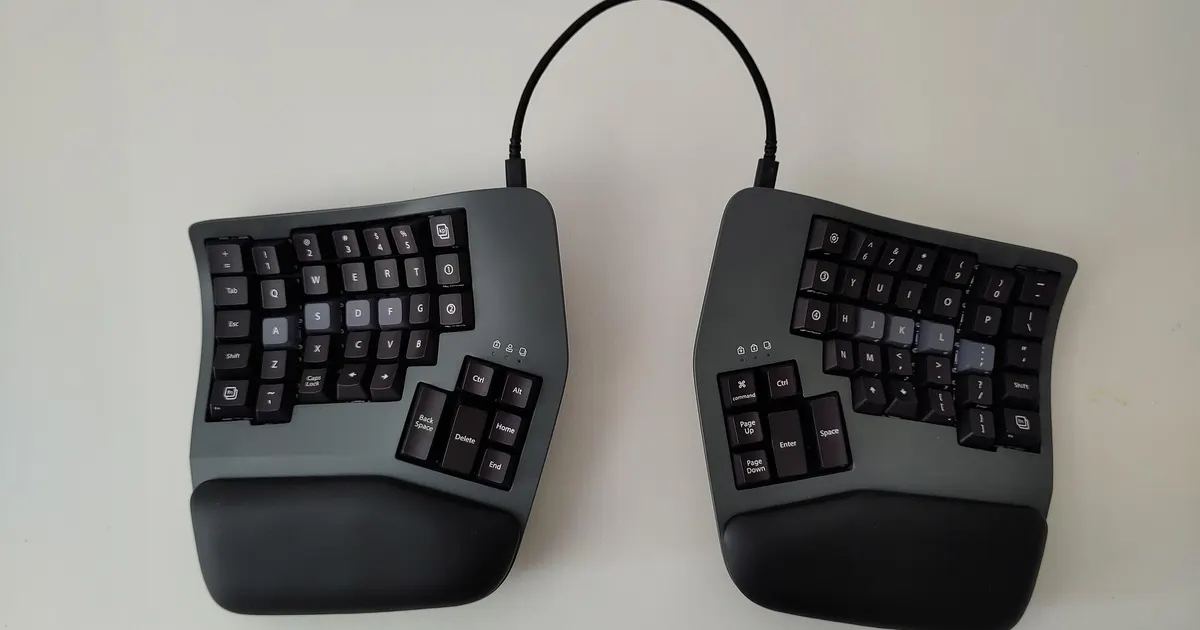
A split keyboard breaks the board into two halves that you place where your hands want them. Designers like the layout, and the ergonomics community has grown it into a large corner of the hobby. For a shop it is a different job from a single case, and the differences show up in the quote, the schedule and the cosmetic inspection.
This guide covers what changes when a case becomes a pair, and what to put in the RFQ so the shop prices the real job.
What makes a split case different
A single case is one part with one set of features. A split pair is two parts, and they share a lot but not everything.
- Mirror images. The left and right halves are mirrored. The same CAD model can be mirrored to make the other half, but the cut programs, fixtures and soft jaws are not interchangeable.
- Differences inside. One half usually holds the microcontroller and the USB port. The other half may have a different connector, such as a TRRS jack or a second USB socket. A wireless pair adds a battery space to each. So the two halves are mirrors outside and different in detail inside.
- A set, not a part. The halves are used together and judged together. A scratch on one half and a clean other half still means a defective set.
- Extras. Palm rests, tenting legs, weights and feet multiply the part count.
None of this is unusual, but it multiplies the number of things that can go wrong, and the way to control it is to treat the pair as the unit of work.
What the part list looks like
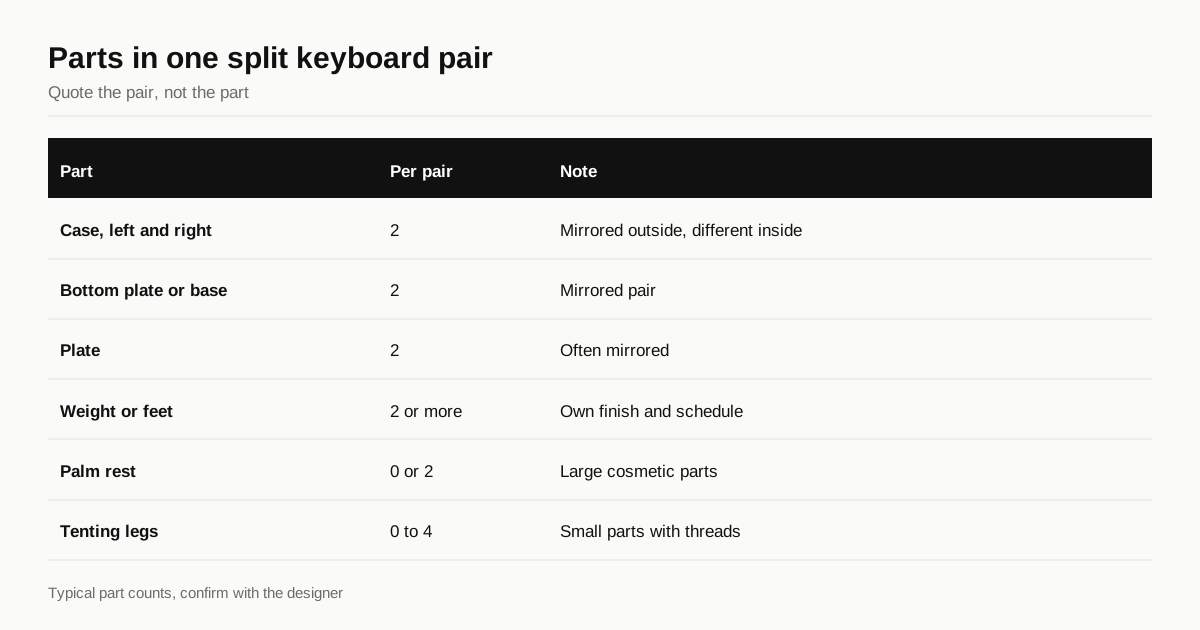
A typical pair has more items than a first-time designer expects.
| Part | Quantity per pair | Notes |
|---|---|---|
| Case, left | 1 | Mirrored from the right with internal changes |
| Case, right | 1 | May hold the controller and USB port |
| Bottom plate or base | 2 | Mirrored, sometimes one design for both |
| Plate | 2 | Often a mirrored pair |
| Weight or feet | 2 or more | Separate parts with their own finish |
| Palm rest | 0 or 2 | A further pair of large cosmetic parts |
| Tenting legs or hinge | 0 to 4 | Small parts, often with threads |
| Screws and inserts | Many | Per half |
A run of a hundred sets is two hundred cases and four hundred or more parts when plates and bases are counted. Minimums and quantity planning follow the logic in keyboard case MOQ, and the unit to quote is the pair.
Machining the halves
A split half is small, and the economics of that depend on the shop’s setup.
- Two up on one fixture. Because each half is short, a shop can often put the left and right half on the same fixture plate and cut both in one setup. That saves handling and probing time and keeps the two halves cut under the same conditions, which helps them match.
- Mirrored programs. The CAM program is mirrored and checked, not just flipped. Features that must not mirror, such as the USB cutout on one side only, are added by hand, and this is where mistakes creep in.
- Block size. A half is far smaller than a 65 percent case, so the block is cheaper. The material saving is real, though it does not halve the price, because machining time per square centimetre stays the same.
- Curved shapes. Ergonomic splits often have angled or curved top surfaces. These need three dimensional tool paths and sometimes a tilted fixture or a five axis machine. See five axis versus three axis for when each makes sense.
The best way to avoid a mix-up is to mark the halves. A small laser mark on the underside, one for left and one for right, makes sorting easy for the shop and for assembly.
What a pair costs compared with one case
It is tempting to assume two small halves cost about the same as one large case of the same total area. In practice the cost lands somewhere else, and three effects explain the gap.
- Fixed costs double. Each half needs its own program, proving and first article, and its own fixture or fixture position. These do not shrink because the part is small.
- Finishing is per rack space. A small part wastes rack space. A tank load holds fewer halves than full cases would fill, so the finishing cost per square centimetre of case rises.
- Inspection doubles. Two parts per unit, with a set check on top.
On the other side, each half uses a smaller block, fits more easily on a small machine and often runs two up on one plate. The two effects tend to cancel for simple halves, and the pair ends up costing somewhat more than a single case of equal total area. For contoured halves with curved surfaces, the three dimensional cutting time dominates and the pair costs clearly more.
Ask the shop for the price per pair and for the split between fixed costs and run costs, so you can see which part of the quote falls as the quantity rises. Quantity breaks work the same way as for a single case, but they are counted in pairs, and a minimum of a hundred cases is only fifty sets.
Colour matching across a pair
The two halves sit next to each other on a desk, so any difference in shade is visible. A pair is also one of the clearest tests of an anodiser’s consistency.
Good practice is simple:
- Anodise both halves in the same rack and batch. The tank and the dye age are the same, so the colour is too.
- Pull the pair together. Do not mix a left from one batch with a right from another.
- Blast both halves together if possible, so the texture is the same.
- Pack and number the pair. A set number on the bag lets the buyer keep a pair together.
When a run is large and spread over several batches, the same principle applies at a larger scale, and the techniques are in colour matching across a run. A golden sample should be a pair.
Inspecting a pair
Inspection adds a step for a split. In addition to the usual flatness, fit and cosmetic checks in the inspection guide, look at the following:
- Handedness. Left is left and right is right. A swapped part is surprisingly easy to produce and surprisingly hard to spot.
- Matching colour and texture across the two halves under the same light.
- Cutout positions. The connector side has its features, and the other side does not.
- Fit of the connecting cable. The two halves must connect and sit as a set.
- Gap and height. Bottoms and tops of both halves should sit at the same height when standing on a desk.
Write a set inspection record, not a part inspection record, so a failing half fails its partner too.
Tenting and angled mounting
Many splits offer tenting, which raises the inner edges of the halves so the hands sit at an angle. It is done with feet, legs or hinged brackets, often with threaded fixings.
- Threaded inserts hold the legs and need a strong thread, because a tenting leg takes more load than an ordinary screw. The options are in screw inserts and tapped holes.
- Mounting holes at an angle. A hole drilled at an angle to the face needs a tilted setup or a five axis machine. Square holes with a spacer are cheaper.
- Flat bottoms. A flat base with a separate adjustable tent is easier to cut than a case with a built-in slope.
If tenting is not essential, keep the case flat and add the angle with a separate part.
Wired and wireless pairs
How the halves connect changes the case.
- Wired between halves. A cable runs from one half to the other, through a connector cutout on each. The cutouts must be sized for the cable boot, as with a USB port, and an off-centre position can be awkward to machine.
- Wireless between halves. Each half carries a battery and an antenna. The case needs room for the cell and, if it is metal, a plan for radio performance. See wireless keyboard case design.
A pair that can be built both ways needs both sets of cutouts, which adds features to every case.
Before you request a quote
- Pair quantity stated, with the part count per pair
- Differences between halves listed: controller, connector, battery
- Left and right marked on the drawing
- Both halves to be anodised together
- Set inspection and pair packing requested
- Tenting, palm rests and extras listed as separate parts
When the pair is ready, send the files through the RFQ form and we will match them with shops that run matched sets of cosmetic aluminium parts.
Frequently asked questions
Is a split keyboard case just two normal cases?
No. The halves are mirror images with differences inside, such as the controller side, the cable connector and the battery pocket on wireless builds. They are programmed, fixtured and inspected as a pair, and the colour must match across both.
Do two halves cost twice as much to machine?
Close to twice the cutting time, but each half is small, so the block is cheaper and two halves often run in one setup. The saving is real but it rarely brings the pair under the price of one large case of similar total area.
Why does colour matching matter more on a split?
The two halves sit side by side on the desk, so a small difference in dye shade is easy to see. Anodising both halves in the same rack and batch keeps them matched, and a pair should be packed and inspected as a set.
Need a quote for your case?
Send the files. We match you with up to 3 shops that machine keyboard cases and reply within 24 business hours.
Get matched with a keyboard case shop