Guides / Design and Fit
Putting a Typing Angle in the Case: Wedge, Feet or Flat, and What Each Costs
November 2, 2026
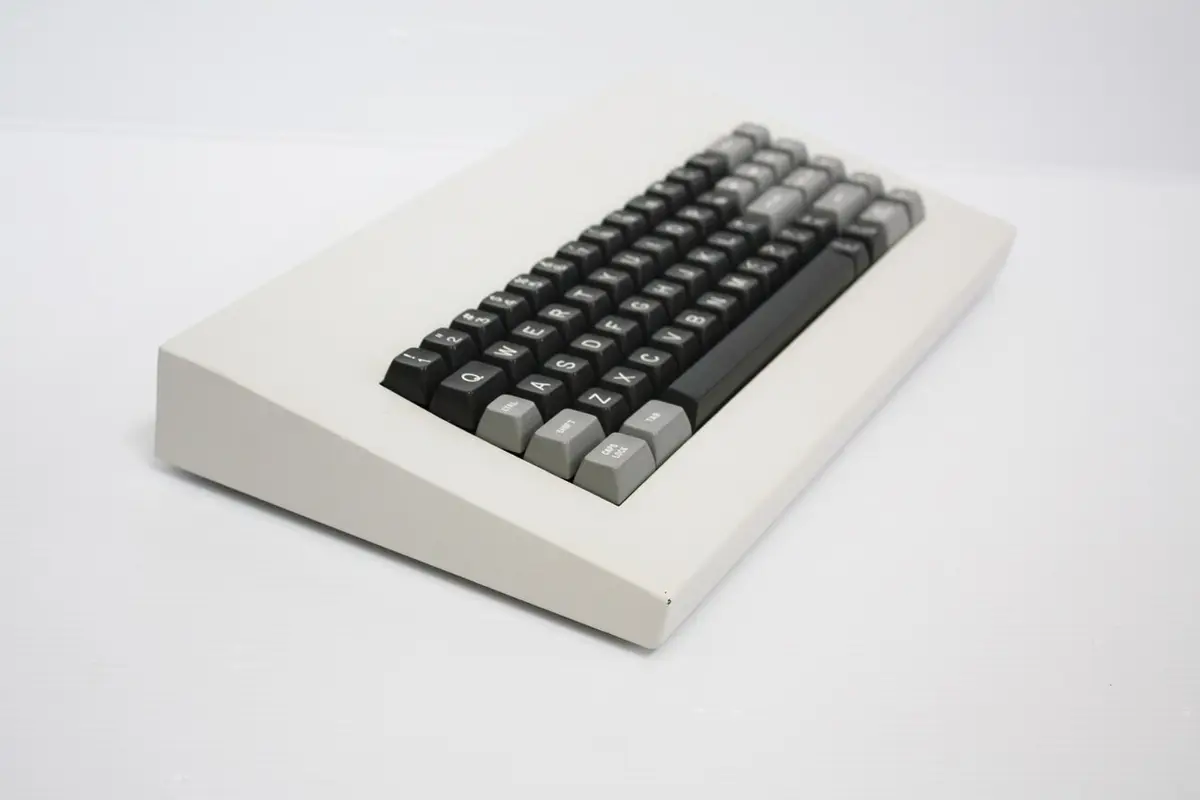
The typing angle of a keyboard case is the slope of the key plane against the desk, and you can build it into the case or leave it to feet. A flat case on feet is the cheapest to machine and the most adjustable. A wedge case costs more, looks cleaner and fixes the angle for good. This guide explains how to choose, what the ergonomic sources say about angle, how to work out the extra stock a wedge needs and what to put on the drawing so a shop quotes it correctly.
The ergonomic notes come from OSHA, CCOHS, a published laboratory study and a patent. None of them sets a required angle for a mechanical keyboard, and the guide says so where it matters. The machining notes follow from geometry and from how a shop holds a part, so they are labelled as practice.
What the sources say about angle
Neither OSHA nor CCOHS names a degree figure. OSHA’s workstation guidance says keyboard tilt, caused by extending the legs on the back of a keyboard, can bend the wrist upward. It advises elevating the back or front to reach a neutral wrist posture and warns against using keyboard feet if they increase wrist bending. CCOHS says the goal is a neutral wrist, in line with the forearm, and suggests keyboards that let the user raise the back or the front.
Two sources give numbers. A 1983 patent, US 4,402,624, says an inclination of 6 degrees from horizontal is functionally preferable for an average size operator. It is a patent claim, not a test result. A 2005 laboratory study in Ergonomics by Babski-Reeves and Woods tested ten experienced typists on keyboards from 0 to minus 30 degrees in 10 degree steps and against a 7 degree positive slope. Wrist posture favoured a flat or negative angle over the positive slope, and minus 10 degrees gave the best net typing speed. Ten typists is a small sample, so read it as a pointer and not a rule.
One retailer’s guide (directional, not independent) says modern keyboards typically carry a positive tilt between 7 and 15 degrees, with built-in or flip-out feet. That describes what is sold. It does not say what is best.
The practical conclusion for a designer: there is no angle to copy. Pick one for the use you expect and give users a way to flatten or reverse it.
Three ways to get an angle
| Approach | Where the angle comes from | Machining effect | Adjustable by the user |
|---|---|---|---|
| Flat case on feet | Rubber feet or flip-out legs | Flat top and flat bottom. Cheapest | Yes |
| Wedge case | A sloped top, a sloped bottom or both | Tilted setup or a 3D tool path. Dearer | No |
| Sculpted case | Curved top and angled sides | Long finishing cuts with a small ball nose tool | No |
The 65 percent case guide covers the cost of each in more detail: a sloped surface cut on a three axis machine leaves scallops that a finishing pass must remove, and a full sculpt can double the cycle time against a flat top. See machining a 65 percent case and the five axis versus three axis guide.
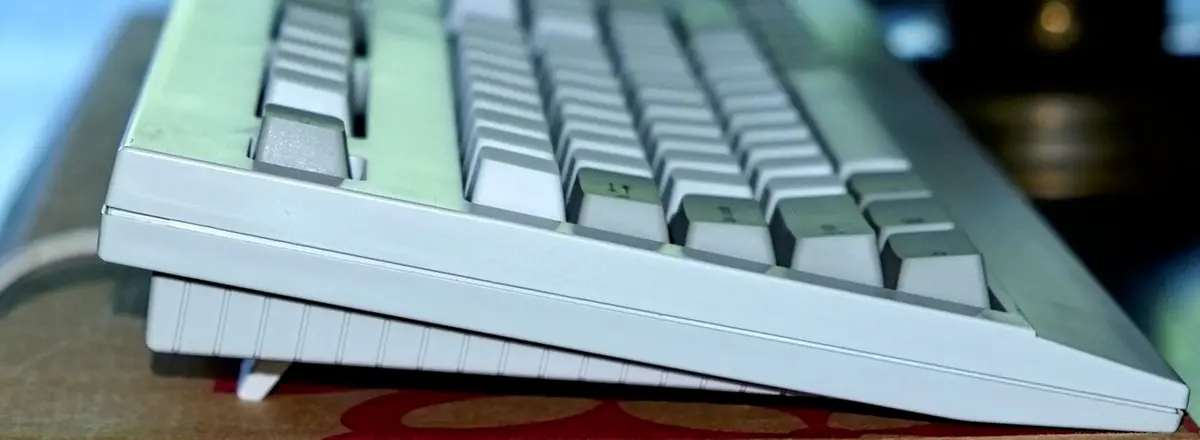
A flat case on feet leaves the decision to the user, which fits OSHA’s point that feet can make wrist posture worse as easily as better. A wedge makes the decision for them. If you cannot say who will use the keyboard, choose feet.
How much stock a wedge needs
The rise from front to back is the case depth multiplied by the sine of the angle. The table below uses a 140 mm deep case as an illustration. Replace 140 with your own depth.
| Angle | Rise over 140 mm |
|---|---|
| 4 degrees | 9.8 mm |
| 6 degrees | 14.6 mm |
| 7 degrees | 17.1 mm |
| 10 degrees | 24.3 mm |
This is geometry, not a shop figure. The blank must be at least as thick as the rear height of the finished case, plus the allowance for facing. So a wedge case starts from thicker plate than a flat case of the same front height, and the extra material is cut away. That is cost in stock and in cutting time. The plate stock guide shows how stock thickness enters the price and the cost drivers guide shows where the time goes.
There is a choice inside a wedge. A sloped top with a flat bottom has the angle on the visible face and keeps the underside simple to hold. A flat top with a sloped bottom gives the same angle seen from the desk, and the shop will hold and cut it differently. Both leave the interior in a plane that must match the plate and the PCB, so the bosses and the plate pocket tilt with the angle. A tilted pocket is a tilted setup on a three axis machine, and a five axis machine can often do it in one hold.
Define the angle so the shop cuts what you mean
Most arguments about angle come from two people measuring different planes. Put these on the drawing.
- Which plane. Say whether the angle is the plane of the plate, the top surface of the case or the bottom. These can differ when a design has a dished top.
- Front height and rear height. Give both, measured at stated points, along with the angle. Height at the front sets the wrist position and a front that is too tall is a common complaint.
- Tolerance. Give the angle as a tolerance in degrees, or give the heights at the two ends with a tolerance each. The tolerance guide explains why a limit on position beats one on size here.
- Flatness of the sloped face. A wedge top is a long flat plane, and any twist shows in the light and on the plate. See the flatness and rock inspection guide.
- Where the feet go. If the wedge also carries feet, say where the pockets or screw positions are, since they sit on a sloped surface.
For a split board, tenting adds a second angle on each half, and the split case guide covers it.
A decision shortcut
- Group buy with a mixed audience: flat case on feet, with feet in more than one height if you can.
- Low-profile or minimalist look: a wedge is the usual route, and the angle is a design feature.
- A small run with a high price: a wedge or a sculpt is affordable, but get the quote with the stock and the extra setup shown, not folded into one number.
- A case meant for a negative angle: make the base thick at the front and check that the front height still suits a wrist rest.
Build a prototype before the run, as the prototype guide argues. A test unit lets you sit at the angle for an hour before you commit to cutting it into a hundred cases.
To compare a wedge and a flat-on-feet quote on the same drawing, send the files through the RFQ form. We match the request with up to 3 shops and reply within 24 business hours.
Sources
- OSHA, computer workstations, keyboards
- CCOHS, office ergonomics, keyboard selection and use
- Babski-Reeves and Woods, Ergonomics 48(15), 2005, via CDC Stacks
- US patent 4,402,624, Device for adjusting the slope of a keyboard
- KeebsForAll, negative vs positive tilt (retailer, directional)
Ergonomic guidance is not medical advice. The rise table is geometry for one example depth, not a quote from a shop.
Frequently asked questions
What is the best typing angle for a keyboard case?
There is no official figure. OSHA and the Canadian CCOHS both say the goal is a neutral wrist, straight and in line with the forearm. One laboratory study of ten typists found that wrist posture favoured a flat or negative angle over a 7 degree positive slope. Choose the angle for your users and offer a way to adjust it.
Is a built-in wedge better than keyboard feet?
A wedge fixes the angle and costs more to machine. Feet keep the case flat on the bottom, cost less and let the user change or remove the angle. OSHA notes that feet should not be used if they increase wrist bending. Flat on feet is the cheaper default and a wedge suits a design that is meant to look sculpted.
How much higher is the back of a wedge case?
The rise equals the case depth multiplied by the sine of the angle. Over a 140 mm deep case, 6 degrees gives about 14.6 mm and 10 degrees about 24.3 mm. The blank must be at least as thick as the rear height, so a larger angle needs thicker plate and costs more in stock and cutting time.
Does a negative typing angle need a different case?
It needs a different base, not a different top. A negative angle raises the front edge, which a wedge with the thick end at the front or a set of front feet can do. Check the front height against the wrist rest, because it adds to the height of the front row.
Need a quote for your case?
Send the files. We match you with up to 3 shops that machine keyboard cases and reply within 24 business hours.
Get matched with a keyboard case shop